Pan American Health Organization · 2020
Public health alert and guidance against use of chlorine-based products for COVID-19 prevention or treatment.
- Issuer
- Pan American Health Organization
- Edition
- 2020
- Audience
- Health authorities, clinicians, public health professionals, regulatory agencies
- Evidence
- Expert consensus based on toxicology data and adverse event reports
- Reviewed
- 21 Oct 2026 · GMJ
What this guideline says
GMJ summary
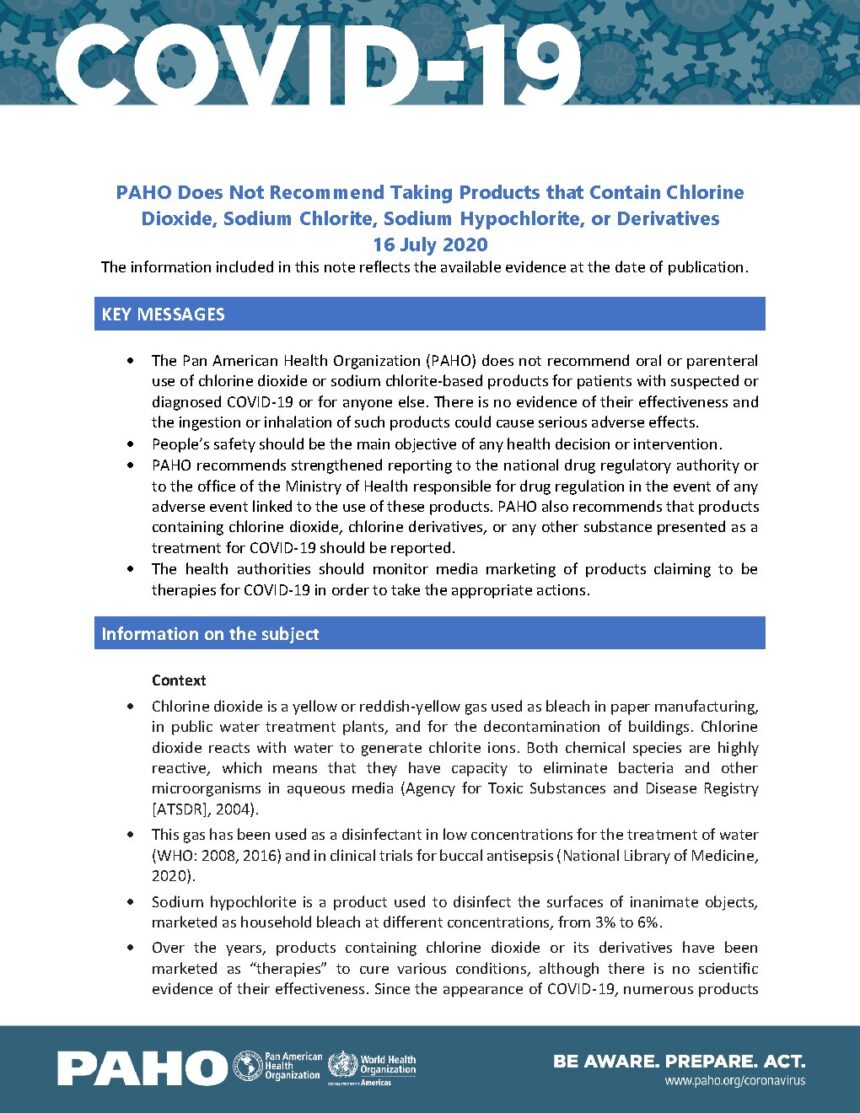
The Pan American Health Organization issued this alert in response to widespread marketing of chlorine dioxide, sodium chlorite, sodium hypochlorite and related products falsely claiming to prevent or cure COVID-19. The document provides strong guidance against oral or parenteral use of these products in patients with suspected or diagnosed COVID-19 or in any other persons.
The central message is unequivocal: there is no evidence of effectiveness for these products against COVID-19, and their ingestion or inhalation can cause serious adverse effects including gastrointestinal illness, haematological disorders (methaemoglobinaemia, haemolysis), cardiovascular complications, renal disorders, respiratory insufficiency, and potentially death. PAHO calls for strengthened adverse event reporting, regulatory action against marketing of such products, and public awareness campaigns.
The guidance responds to multiple reports from countries across the Americas documenting marketing of products such as ‘Miracle Mineral Solution’ (MMS), typically containing sodium chlorite at 28% strength with instructions to mix with acidic solutions. Health authorities in Peru, Colombia, Ecuador, Bolivia, Paraguay, Argentina and Honduras had all issued alerts by mid-2020.
Key points
For clinicians — doses and thresholds as stated in the guideline
- Do not use chlorine dioxide, sodium chlorite, sodium hypochlorite or derivatives orally or parenterally for COVID-19 prevention or treatment—no evidence of effectiveness exists
- These products cause serious adverse effects: gastrointestinal illness (nausea, vomiting, diarrhoea), methaemoglobinaemia, haemolysis, cardiovascular disorders, renal disorders, and respiratory insufficiency
- Inhalation through nebulisers can cause pulmonary oedema, bronchial spasms, chemical pneumonitis, glottic oedema, and death if exposure exceeds occupational limits
- Products marketed as 'Miracle Mineral Solution' (MMS) typically contain 28% sodium chlorite in distilled water with instructions to mix with lemon, lime or other acidic solutions—warn patients against purchasing these
- Report all adverse events related to these products to national drug regulatory authorities immediately
- Monitor and report marketing of any products containing chlorine dioxide or derivatives claiming to treat COVID-19
- Health authorities should take regulatory action including sanctions against sellers of these products
- Patient safety must be the primary objective—counsel patients that these products are industrial disinfectants, not medicines
From the guideline
Verbatim
“PAHO does not recommend oral or parenteral use of chlorine dioxide or sodium chlorite-based products for patients with suspected or diagnosed COVID-19 or for anyone else.”
Editor’s perspective
Why this matters for Georgia and the region
Prof. Giorgi Pkhakadze, MD, MPH, PhD
Editor-in-Chief, Georgian Medical Journal · Chair, Public Health Institute of Georgia · WHO consultant, health and migration
As Editor-in-Chief of the Georgian Medical Journal and WHO consultant, I find this PAHO alert critically important for Georgia and neighbouring countries where misinformation about COVID-19 treatments remains a public health challenge. Georgian clinicians must actively counsel patients against these products, particularly as online marketing channels make them readily accessible despite lack of regulatory approval. The most important action for our region is establishing robust adverse event reporting through the Georgian Medicines Agency and strengthening coordination between poison control centres across the South Caucasus, mirroring the successful REDCIATOX network in Latin America. The realistic implementation challenge is that many patients may not disclose use of such products unless directly asked, so clinicians must routinely enquire about alternative treatments when evaluating patients with unexplained gastrointestinal, haematological or respiratory symptoms.
ORCID 0000-0001-7609-4515 · Perspective written for the GMJ Guidelines Library, 21 Oct 2026
Applicability
Georgia and the South Caucasus
This guidance remains highly relevant for Georgia and the South Caucasus region, where COVID-19 misinformation continues to circulate and access to unregulated products through online channels is widespread. Georgian health authorities should ensure that pharmacovigilance systems capture adverse events related to chlorine-based products, and that the Georgian Medicines Agency monitors both physical and online marketing channels for these products. Public health messaging programmes should specifically address this hazard, particularly given the vulnerability of populations seeking alternative treatments during ongoing respiratory illness seasons. National poison control centres in Georgia, Armenia and Azerbaijan should coordinate reporting and public alerts similar to the networks established in Latin America.
Questions this guideline answers
Quick answers
What are chlorine dioxide and sodium chlorite normally used for?
Chlorine dioxide is a yellow or reddish-yellow gas used as bleach in paper manufacturing, in public water treatment plants, and for building decontamination. Sodium hypochlorite is used to disinfect inanimate surfaces and is marketed as household bleach at 3–6% concentrations. These are industrial disinfectants, not medicines.
What adverse effects have been reported from ingestion of these products?
The US FDA received reports of serious adverse events including respiratory insufficiency, cardiac electrical activity alterations, hypotension, liver insufficiency, anaemia, and severe vomiting and diarrhoea. Other documented effects include methaemoglobinaemia, haemolysis, cardiovascular and renal disorders, and drop in blood pressure causing respiratory complications due to altered oxygen transport capacity.
What is 'Miracle Mineral Solution' (MMS)?
MMS is a product containing sodium chlorite at 28% strength in distilled water, marketed with instructions to mix it with lemon, lime juice or other acidic solutions. It has been falsely promoted as a treatment for COVID-19 and other conditions. Multiple countries in the Americas have issued specific alerts against this product, which has no health registration and is not a medicine.
What should I do if a patient reports using these products?
Immediately advise discontinuation. Assess for signs of toxicity including gastrointestinal symptoms, respiratory distress, cardiovascular instability, and haematological abnormalities. Report the adverse event to your national drug regulatory authority or Ministry of Health office responsible for drug regulation. Provide supportive care as needed and monitor for complications.
Related on GMJ
Interconnected resources
Dictionary of Public Health
GMJ News coverage
Quality & accreditation
Other guidelines on this topic
- Essential Medicines List for Management of Patients Admitted to Intensive Care Units with Suspected or Confirmed COVID-19 Diagnosis
- Considerations for Regulatory Oversight of Clinical Trials in the COVID-19 Pandemic
- Recommendations for medical surge capacity and deployment of emergency medical teams
- Guidelines for care of critically ill adult patients with COVID-19 in the Americas
- Template and operational guidance for the ethics review and oversight of COVID-19-related research
- Issuer
- Pan American Health Organization
- Type
- Procedures, manuals, guidelines
- Status
- Current
- Published
- 2020-01-01
- Scope
- Regional guidance for the Americas applicable globally
- Audience
- Health authorities, clinicians, public health professionals, regulatory agencies
- Licence
- CC BY-NC-SA 3.0 IGO
- Evidence
- Expert consensus based on toxicology data and adverse event reports
- Record history
- Created 21 Oct 2026 · updated 21 Oct 2026 · next check Apr 2027
Pan American Health Organization. PAHO Does Not Recommend Taking Products that Contain Chlorine Dioxide, Sodium Chlorite, Sodium Hypochlorite, or Derivatives. Washington, D.C.: PAHO; 2020. (PAHO/IMS/PHE/COVID-19/20-0040).GMJ Guidelines Library records are original summaries written by the GMJ editorial team from the issuer’s published document and reviewed by a physician. They do not replace the full guideline. The document is the copyright of its issuer and is linked, not hosted. Spotted an error or a newer edition? Tell the Guidelines Desk.
Was this article helpful?