
Updated 13/09/2026
Photo: File:Cobalt Chromium Coronary Stent in Heart.png, by ETTon (Wikimedia), cropped for layout · Licensed CC BY-SA 4.0 · Source
Plain-language summary of research published in the Georgian Medical Journal. Written for the general public by the GMJ News editorial team.
When coronary bypass surgery uses a vein graft (rather than an artery) and that graft later degenerates or clogs, reopening it with angioplasty is notoriously complex — carrying a high risk of complications like massive distal embolisation. A retrospective study in the Georgian Medical Journal, tracking 238 patients treated over a decade, shows how the field’s own techniques evolved to make that procedure safer.

The Two Study Groups
Researchers conducted a retrospective study of patients who underwent angioplasty of saphenous vein grafts (SVGs) between 2005 and 2015 at a tertiary care hospital, split into two comparison groups: 2005–2009 (group A) and 2010–2015 (group B). Among the 238 patients overall, 226 (95%) were male, with heavy comorbidity burden throughout: 74.4% had hypertension, 56.3% had diabetes, 17.2% had chronic kidney disease, and 99% had a history of prior myocardial infarction. 62% were admitted for acute coronary syndrome.
What Changed Between the Two Eras
The comparison across the two time periods reveals a technology-driven safety shift: distal protection devices, designed to catch debris before it can embolise downstream, were used in only 31 patients (22%) overall — but their use rose sharply over time, from 9.5% in group A to 36.4% in group B (p=0.0002). Covered stents, which help seal off degenerated graft material, followed the same trajectory: 2.1% to 18.8% (p=0.003). The amount of contrast material used per procedure dropped too, from 186 mL to 137 mL (p=0.0018) — a meaningful reduction given contrast’s own kidney-injury risk in patients who already carry high rates of chronic kidney disease.

At a glance — the headline figures.
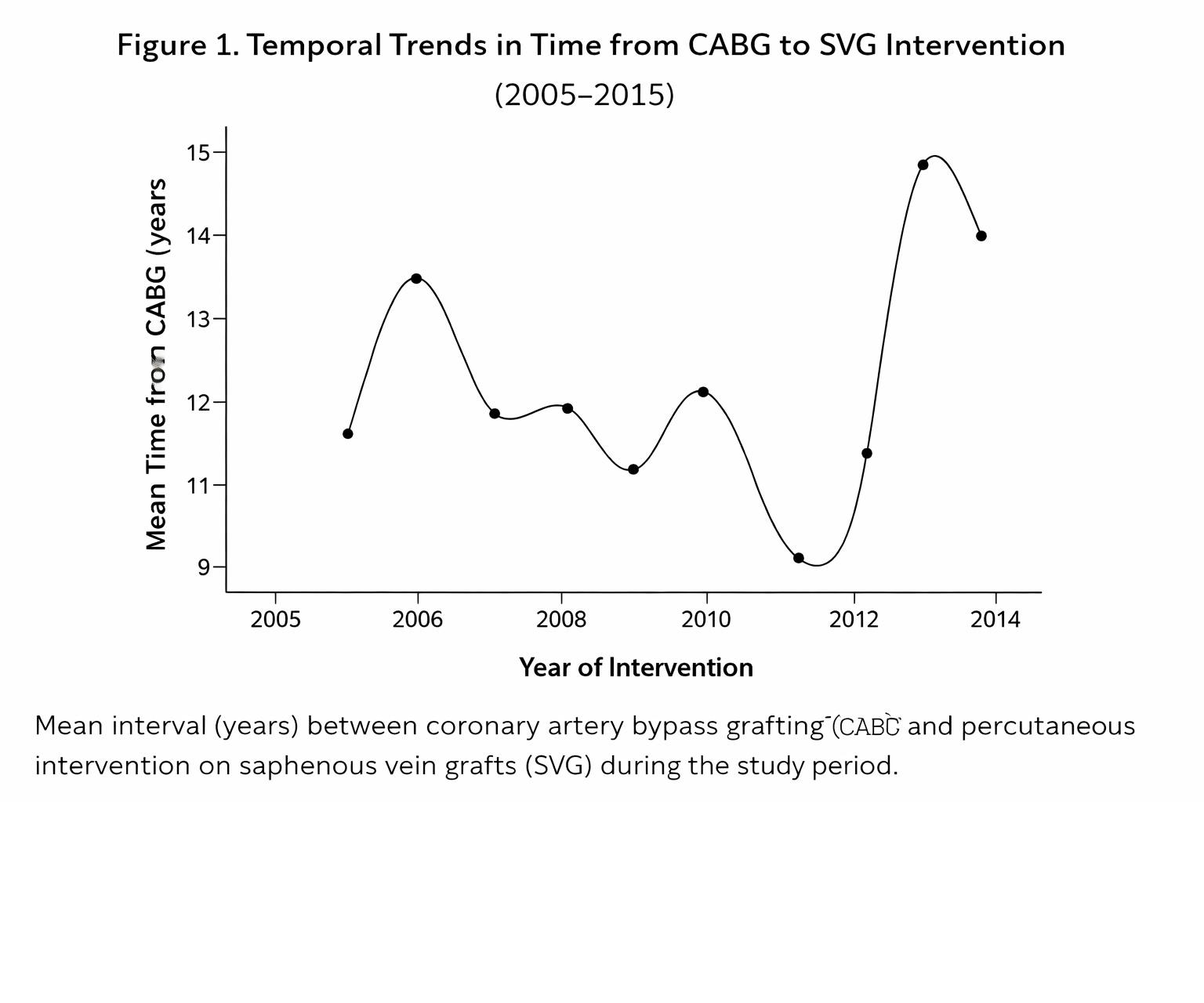
Mean interval (years) between coronary artery bypass grafting (CABG) and percutaneous intervention on saphenous vein grafts (SVG), 2005–2015. Figure from the study. Source: Georgian Medical Journal, Vol. 1 No. 1 (2026), DOI: 10.5281/zenodo.19136330.
The conclusion is a genuine technology success story with a twist: as protection devices and covered stents became more common, complication rates and contrast-related kidney injury fell — but at the same time, clinicians increasingly found themselves treating more severely ill patients with longer-since-surgery, “older” grafts, meaning the population being treated got harder even as the tools to treat them got better. The study’s proposed treatment algorithm is built directly from this decade of comparative data, aimed at giving interventional cardiologists a clearer path through an inherently high-risk procedure.
🗺️ Find certified Georgian healthcare providers: sheniekimi.ge — Georgia Health Map · 998 clinics · 6,600+ doctors · 2,296 pharmacies
Read the Original Research
Original article: When Bypass Grafts Clog: Reopening the Heart’s Detours
Published in: Georgian Medical Journal, Vol. 1 No. 1 (2026)
DOI: 10.5281/zenodo.19136330
📄 Read the full article at gmj.ge →
Georgian Medical Journal (GMJ) · ISSN 3088-4322 · gmj.ge · Open Access CC BY 4.0 · Published by the Public Health Institute of Georgia (PHIG). This summary is an independent editorial product of GMJ News; for clinical decisions, consult the original peer-reviewed article and a qualified professional.
Was this article helpful?
Disclaimer. This article is health journalism intended for general information and education. It is not medical advice and is not a substitute for professional diagnosis or treatment. Always consult a qualified healthcare provider about your individual circumstances. Full disclaimer →
Related Coverage




Editorial standards. This article was produced under the GMJ News editorial process, with oversight by the GMJ Editorial Board. Our editorial process. Spotted an error? Contact the editorial team.