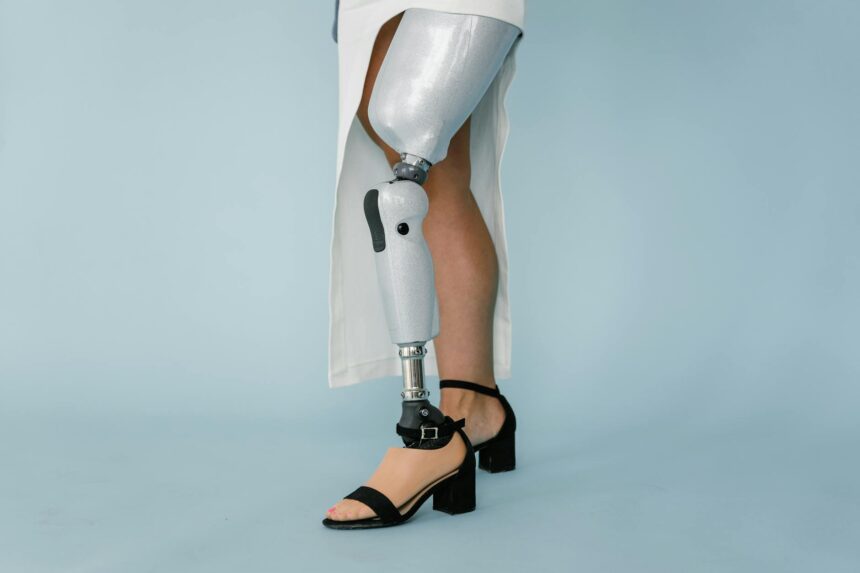
Researchers have developed and validated a reliable, low-cost method for assessing mechanical wear in prosthetic feet that could transform device monitoring in resource-constrained settings. The study, published in PLOS Global Public Health, demonstrates that a grid-based visual scoring system shows strong inter-observer reliability for monitoring prosthetic foot deterioration.
Inter-observer agreement levels for prosthetic foot wear assessment
Kendall’s W reliability scores across different dataset configurations, 2024
Source: Berthaume et al., PLOS Global Public Health, 2024 | Georgian Medical Journal News
Grid method shows strong reliability across observer groups
The research team, led by Dr. Michael A. Berthaume at Imperial College London, tested their assessment method on 62 plantar images of used SACH (Solid Ankle Cushioned Heel) feet collected from Sri Lanka. Four independent observer groups scored wear patterns using a 20×10 grid overlay, rating each cell from 0-9 based on visual wear indicators.

According to the published findings, inter-observer agreement ranged from fair to excellent, with Kendall’s W reliability scores reaching 0.88 in the reduced three-rater dataset. The method demonstrated particularly high reliability in central, less-worn areas of prosthetic feet where agreement exceeded 0.92.
“This represents a significant advance for global health applications,” noted the research team. The visual scoring system requires only basic photography equipment and trained observers, making it accessible in settings where sophisticated laboratory testing is unavailable.
Method addresses critical gap in low-resource settings
Prosthetic foot wear assessment has traditionally relied on expensive laboratory equipment or subjective clinical judgement, creating barriers to systematic monitoring in rural and resource-constrained areas. The World Health Organization estimates that over 1 billion people need assistive technology, yet access remains severely limited in many regions.
The grid-based method addresses this gap by providing a standardized, field-appropriate tool that can be implemented without specialized equipment. Intra-observer reliability testing showed high consistency when the same raters re-scored images after five or more days, particularly in central foot regions that experience moderate wear patterns.
For broader clinical applications, the research supports using a reduced three-rater approach that maintains strong reliability while being more practical to implement. This finding has important implications for quality and safety monitoring in prosthetic care programs worldwide.
Modified scoring approach reduces variability
The researchers also developed and tested a modified scoring method that showed reduced intra-observer variability, though with slightly lower inter-observer agreement scores. According to the study authors, this reduction was primarily due to increased statistical ties affecting the Kendall’s W calculation rather than genuine disagreement between observers.
The original method provides higher resolution data for detailed wear analysis, while the reduced approach offers broader applicability across different prosthetic foot types. Both approaches demonstrated sufficient reliability for clinical implementation, allowing programs to select the most appropriate method based on their specific needs and resources.
This flexibility makes the assessment tool particularly valuable for organizations working in diverse settings with varying technical capacity and staff availability.
Inter-observer agreement ranged from fair to excellent, with the reduced three-rater dataset achieving Kendall’s W reliability scores of 0.88, supporting clinical implementation of the grid-based assessment method.
— Dr. Michael A. Berthaume, Imperial College London (PLOS Global Public Health, 2024)
Key takeaways
- Grid-based visual scoring system achieves 0.88 inter-observer reliability with three raters
- Method requires only basic photography equipment, making it accessible in resource-limited settings
- Central foot areas show highest assessment reliability at 0.92 agreement scores
- Both full and reduced scoring approaches demonstrate sufficient reliability for clinical use
Frequently asked questions
How does the grid-based assessment method work?
Observers apply a 20×10 grid overlay to photographs of prosthetic foot plantar surfaces and score each cell from 0-9 based on visual wear indicators. This systematic approach provides standardized quantification of wear patterns and magnitude across the entire foot surface.
What equipment is needed to implement this assessment method?
The method requires only basic photography equipment and trained observers, making it significantly more accessible than traditional laboratory-based wear testing. This low-cost approach is specifically designed for field use in resource-constrained settings.
How reliable is the assessment compared to laboratory methods?
The study demonstrated fair to excellent inter-observer agreement with Kendall’s W scores reaching 0.88, indicating strong reliability for clinical applications. While not replacing laboratory analysis, it provides a practical alternative for systematic monitoring where sophisticated testing is unavailable.
The validation of this grid-based assessment method represents an important step toward improving prosthetic care monitoring globally. As implementation expands, the tool could enhance both clinical practice and research into prosthetic device performance, ultimately supporting better outcomes for users worldwide. The method’s scalability and low cost make it particularly promising for addressing the significant gaps in assistive technology access identified by international health organizations.
Source: A reliable and inclusive method for assessing failure-causing mechanical wear in prosthetic feet
Was this article helpful?
Disclaimer. This article is health journalism intended for general information and education. It is not medical advice and is not a substitute for professional diagnosis or treatment. Always consult a qualified healthcare provider about your individual circumstances. Full disclaimer →
Related Coverage




Medically reviewed by Prof. Giorgi Pkhakadze, MD, MPH, PhD. Spotted an error? Contact the editorial team.