Pan American Health Organization · 2020
Guidance for health systems on selecting, evaluating and authorizing COVID-19 diagnostic tests during the pandemic emergency.
- Issuer
- Pan American Health Organization
- Edition
- 2020
- Audience
- National health authorities, regulatory agencies, public health laboratories, procurement officers
- Evidence
- Expert guidance based on regulatory frameworks and diagnostic technology assessment
- Reviewed
- 19 Oct 2026 · GMJ
What this guideline says
GMJ summary
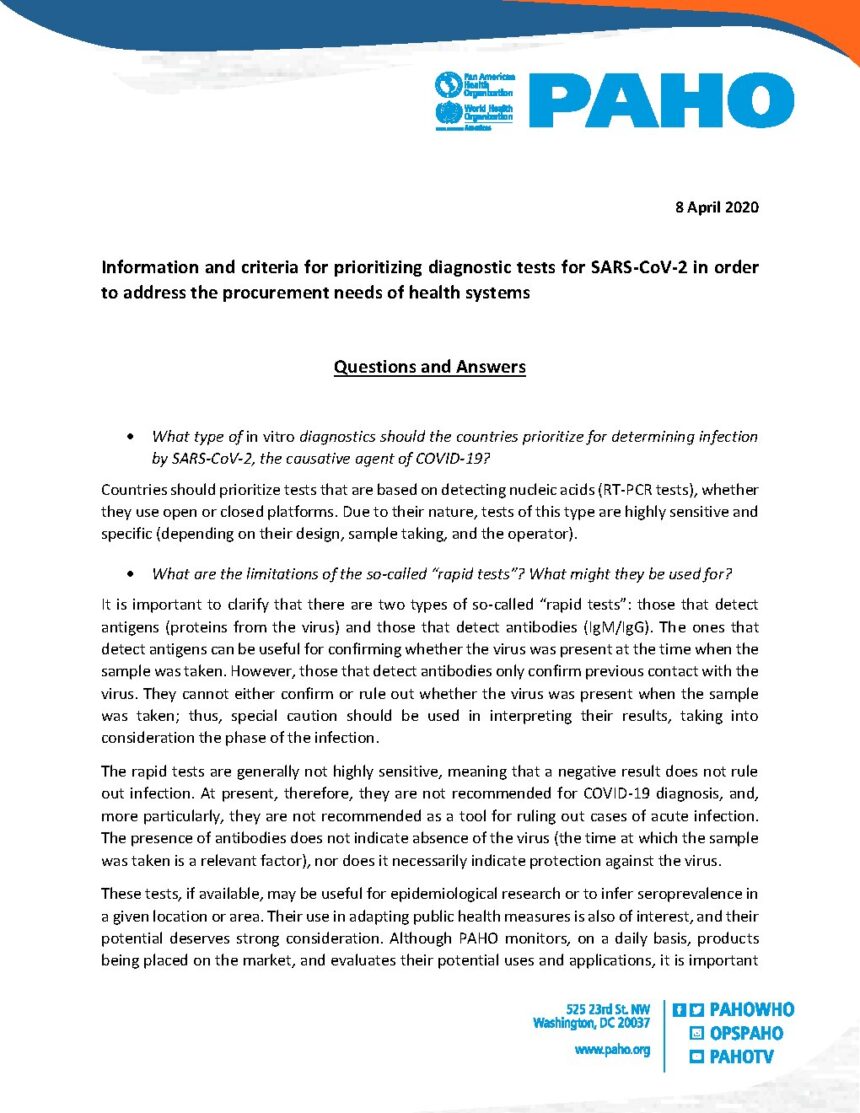
This guidance document from the Pan American Health Organization provides criteria for prioritizing and procuring SARS-CoV-2 diagnostic tests. It recommends that countries prioritize nucleic acid detection tests (RT-PCR) on open or closed platforms due to their high sensitivity and specificity, whilst recognizing limitations of rapid antigen and antibody tests for acute infection diagnosis.
The document outlines quality assurance mechanisms for commercial diagnostic products, including regulatory reliance on Stringent Regulatory Authorities (SRAs) such as the US FDA, Health Canada, Australia’s TGA, Japan’s MHLW, and Singapore’s HSA. It describes the WHO Emergency Use List (EUL) as a rapid review mechanism for recommending critical diagnostic products during health emergencies, providing an alternative to lengthy prequalification processes.
Special emphasis is placed on the distinction between rapid antigen tests (which detect current viral presence) and antibody tests (which only confirm previous exposure). The guidance stresses that antibody tests cannot confirm or rule out acute infection and are not recommended for COVID-19 diagnosis, though they may be useful for epidemiological research and seroprevalence studies.
Key points
For clinicians — doses and thresholds as stated in the guideline
- Countries should prioritize nucleic acid detection tests (RT-PCR) on open or closed platforms due to their high sensitivity and specificity
- Rapid antibody tests (IgM/IgG) cannot confirm or rule out acute infection and are not recommended for COVID-19 diagnosis
- Rapid antigen tests can confirm viral presence at the time of sampling but generally have low sensitivity; negative results do not rule out infection
- Commercial products should be evaluated based on regulatory status by Stringent Regulatory Authorities (FDA, Health Canada, TGA, MHLW, HSA)
- Countries should validate rapid tests using panels of previously characterized samples under appropriate laboratory conditions before implementation
- Products from the WHO Emergency Use List (EUL) are recommended for procurement by UN and national health systems
- Emergency authorization processes should balance timely access with quality control based on risk analysis
- Post-marketing surveillance must be implemented to monitor product performance and enable corrective actions
WHO-recognized Stringent Regulatory Authorities for COVID-19 diagnostics
Table extracted from the guideline
| Regulatory Authority | Country | Website |
|---|---|---|
| Food and Drug Administration (FDA) | United States | https://www.fda.gov/medical-devices/emergency-situations-medical-devices/emergency-use-authorizations#covid19ivd |
| Health Canada | Canada | https://www.canada.ca/en/health-canada/services/drugs-health-products/medical-devices/covid-19/diagnostic-devices-authorized.html |
| Therapeutic Goods Administration | Australia | https://www.tga.gov.au/covid-19-test-kits-included-artg-legal-supply-australia |
| Ministry of Health, Labour and Welfare | Japan | https://www.mhlw.go.jp/english/ |
| Health Sciences Authority | Singapore | https://www.hsa.gov.sg/announcements/regulatory-updates/hsa-expedites-approval-of-covid-19-diagnostic-tests-in-singapore-via-provisional-authorisation |
Source: Pan American Health Organization, Information and criteria for prioritizing diagnostic tests for SARS-CoV-2 in order to address the procurement needs of health systems. Reproduced in summary form.
From the guideline
Verbatim
“Countries should prioritize tests that are based on detecting nucleic acids (RT-PCR tests), whether they use open or closed platforms.”
Editor’s perspective
Why this matters for Georgia and the region
Prof. Giorgi Pkhakadze, MD, MPH, PhD
Editor-in-Chief, Georgian Medical Journal · Chair, Public Health Institute of Georgia · WHO consultant, health and migration
As Georgia continues to strengthen its diagnostic capacity for emerging infectious diseases, this PAHO guidance provides essential criteria for our national regulatory authority and public health laboratories. The distinction between RT-PCR tests, which should remain our diagnostic gold standard, and rapid antibody tests, which have been widely marketed but cannot diagnose acute infection, is critical for clinicians and laboratory directors to understand. Georgia's National Centre for Disease Control should prioritize validation of commercial RT-PCR platforms that can be deployed beyond the National Reference Laboratory to regional centres, ensuring adequate thermocycler equipment and trained personnel. The regulatory reliance framework outlined here—referencing decisions by FDA, Health Canada or the WHO Emergency Use List—offers a pragmatic pathway for our national medicines agency to authorize quality diagnostics rapidly, though we must ensure post-marketing surveillance capacity to monitor performance in our local context.
ORCID 0000-0001-7609-4515 · Perspective written for the GMJ Guidelines Library, 19 Oct 2026
Applicability
Georgia and the South Caucasus
For Georgia and other countries in the South Caucasus and Eastern Europe, this guidance provides a framework for establishing regulatory reliance mechanisms when procuring COVID-19 diagnostics, particularly relevant given limited national capacity for independent validation of emerging diagnostic products. National regulatory authorities should consider implementing emergency authorization processes that reference decisions by WHO-recognized Stringent Regulatory Authorities or the WHO Emergency Use List. Countries should ensure that public health laboratories have adequate biosafety conditions and trained personnel for implementing RT-PCR tests, whilst clinical laboratories require appropriate equipment (thermocyclers) and biosafety infrastructure. The guidance on validating rapid tests before implementation is particularly important for resource-limited settings considering lower-cost diagnostic options.
Questions this guideline answers
Quick answers
What type of diagnostic test should countries prioritize for COVID-19?
Countries should prioritize nucleic acid detection tests (RT-PCR) on open or closed platforms due to their high sensitivity and specificity, depending on design, sample collection and operator skill.
Can rapid antibody tests be used to diagnose acute COVID-19 infection?
No. Rapid antibody tests (IgM/IgG) only confirm previous contact with the virus and cannot confirm or rule out whether the virus was present when the sample was taken. They are not recommended for COVID-19 diagnosis.
What are the limitations of rapid antigen tests?
Rapid tests are generally not highly sensitive, meaning a negative result does not rule out infection. They are not recommended as a tool for ruling out cases of acute infection, though antigen tests can be useful for confirming viral presence at the time of sampling.
How can countries evaluate the quality of commercial COVID-19 diagnostic products?
Countries should first assess the product's regulatory status through national authorities' quality control processes, or use regulatory reliance on WHO-recognized Stringent Regulatory Authorities (FDA, Health Canada, TGA, MHLW, HSA) or the WHO Emergency Use List. WHO and FIND are also collaborating on performance evaluations of COVID-19 tests.
Related on GMJ
Interconnected resources
Dictionary of Public Health
GMJ News coverage
Quality & accreditation
- ASF Hospital — Standard 13 — Radiology
- ASF Laboratory — Standard 4 — Equipment, Reagents & Traceability
- ASF Hospital — Standard 7 — Governance & Management
- ASF Hospital — Standard 5 — Safety & Emergency Preparedness
- ASF Hospital — Standard 4 — Care & Treatment
- ASF Hospital — Standard 11 — Critical Care
- ASF Medical Transport — Standard 6 — Emergency Response During Transport
Other guidelines on this topic
- The COVID-19 Risk Communication Package for Healthcare Facilities
- How Can Research Transparency Be Promoted? Actions for National Health Authorities During the COVID-19 Pandemic
- COVID-19 Recommended Interventions in Mental Health and Psychosocial Support (MHPSS) during the Pandemic
- Ongoing Living Update of Potential COVID-19 Therapeutics: summary of rapid systematic reviews
- Reorganization and Progressive Expansion of Health Services for the Response to the COVID-19 Pandemic
- Issuer
- Pan American Health Organization
- Type
- Procedures, manuals, guidelines
- Status
- Current
- Published
- 2020-01-01
- Scope
- Procurement and prioritization of SARS-CoV-2 diagnostic tests
- Audience
- National health authorities, regulatory agencies, public health laboratories, procurement officers
- Licence
- CC BY-NC-SA 3.0 IGO
- Evidence
- Expert guidance based on regulatory frameworks and diagnostic technology assessment
- Record history
- Created 19 Oct 2026 · updated 19 Oct 2026 · next check Apr 2027
Pan American Health Organization. Information and criteria for prioritizing diagnostic tests for SARS-CoV-2 in order to address the procurement needs of health systems, 8 April 2020. Washington, D.C.: PAHO; 2020. Reference Number: PAHO/PHE/IHM/COVID-19/20-0010.GMJ Guidelines Library records are original summaries written by the GMJ editorial team from the issuer’s published document and reviewed by a physician. They do not replace the full guideline. The document is the copyright of its issuer and is linked, not hosted. Spotted an error or a newer edition? Tell the Guidelines Desk.
Was this article helpful?