Pan American Health Organization · 2020
Comprehensive water, sanitation, hygiene, waste management and infection prevention standards for healthcare facilities.
- Issuer
- Pan American Health Organization
- Edition
- 2020
- Audience
- Healthcare facility managers, infection prevention personnel, environmental health staff, water and sanitation operators
- Evidence
- Expert consensus
- Reviewed
- 20 Oct 2026 · GMJ
What this guideline says
GMJ summary
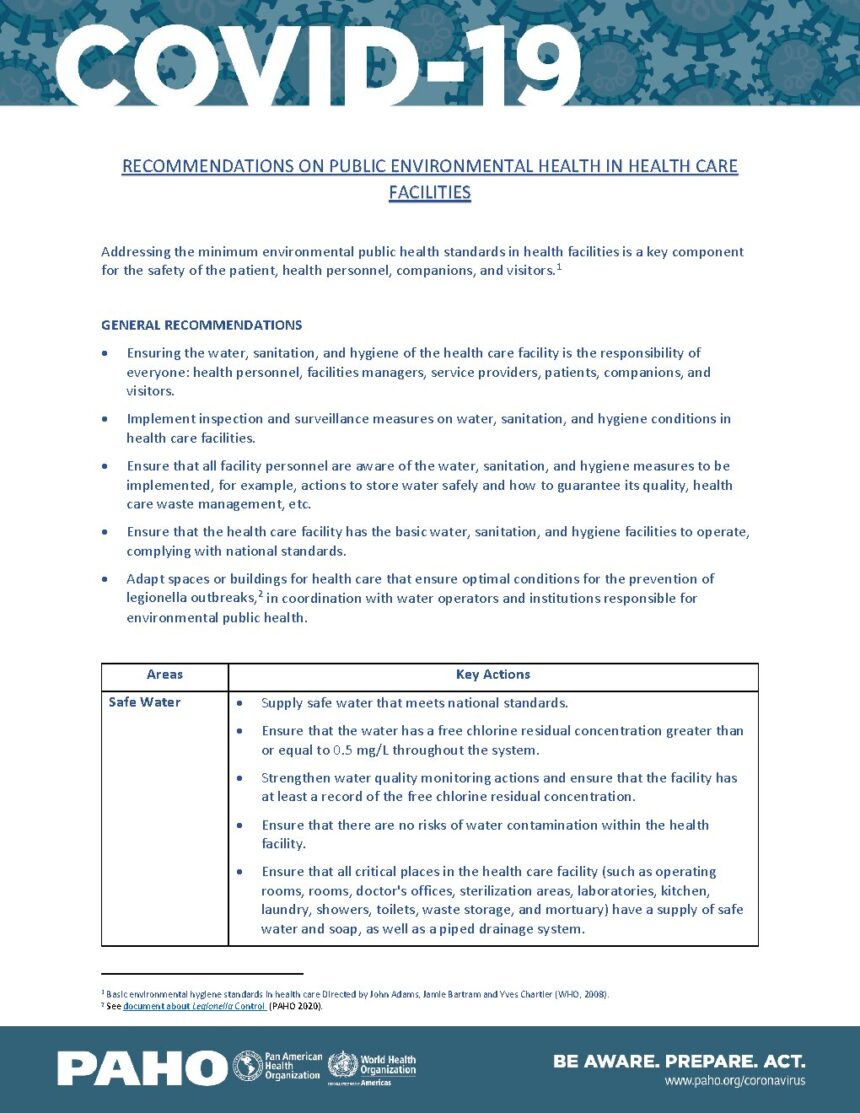
This PAHO guidance establishes minimum environmental public health standards for healthcare facilities to ensure the safety of patients, health personnel, companions and visitors. The recommendations address six core areas: safe water supply, sanitation, solid waste management, hand hygiene, ventilation and cleaning/disinfection practices.
The document provides detailed specifications including maintaining free chlorine residual concentration ≥0.5 mg/L throughout water systems, ensuring at least 4 designated toilets plus additional facilities based on bed numbers, and implementing six-category waste segregation (sharps, infectious, pathological, chemical/pharmaceutical, radioactive and common waste). Specific protocols are provided for autoclave sterilisation (121–134°C for 20–40 minutes) and incineration (double-chamber at 850°C and 1100°C).
The guidance emphasises universal responsibility for water, sanitation and hygiene (WASH) among all facility stakeholders and includes practical instructions for preparing sodium hypochlorite disinfection solutions at 0.05%, 0.1% and 0.5% concentrations for different applications, along with minimum environmental health kit requirements for implementation.
Key points
For clinicians — doses and thresholds as stated in the guideline
- Maintain free chlorine residual concentration ≥0.5 mg/L throughout the water system at all times
- Provide at least 4 designated toilets (1 staff, 3 patients) plus 1 toilet per 10 beds (or per 20 outpatients) in long-term facilities, and 1 per 20 beds (or per 50 outpatients) in short-term facilities
- Secure 1 shower for every 40 users, separated by staff/patients and sex
- Disinfect surfaces with sodium hypochlorite 0.1% solution (leaving 1 minute contact time), ethanol 70–90% (1 minute) or hydrogen peroxide 0.5% (1 minute) to achieve 99.9% reduction of SARS-CoV-2
- Segregate waste into six categories using colour-coded containers: red for infectious waste (15–40 L with lid), black for common waste (20–60 L), yellow for sharps (seal at 80% capacity)
- Autoclave infectious waste at 121–134°C for 20–40 minutes at 103–200 kPa with HEPA filtration; or use double-chamber incineration at 850°C and 1100°C with 2-second gas burning time
- Ensure minimum 2 air exchanges per hour in patient care spaces, maintain humidity 40–60% and temperature 21–24°C, and keep at least 10 m distance between air discharge and intake points
- Wash contaminated laundry in hot water and soap, soak 30 minutes in 0.05% sodium hypochlorite solution, rinse and dry
Sodium hypochlorite disinfection solution preparation guide
Table extracted from the guideline
| Sodium hypochlorite concentration | 0.05% solution (hand washing, laundry) | 0.1% solution (surfaces, floors, utensils) | 0.5% solution (body fluid spills) |
|---|---|---|---|
| 1% | 50 ml in 1 L water | 100 ml in 1 L water | 500 ml in 1 L water |
| 3% | 15 ml in 1 L water | 30 ml in 1 L water | 154 ml in 846 ml water |
| 4% | 13 ml in 1 L water | 25 ml in 1 L water | 125 ml in 875 ml water |
| 5% | 10 ml in 1 L water | 20 ml in 1 L water | 100 ml in 1 L water |
| 10% | 5 ml in 1 L water | 10 ml in 1 L water | 50 ml in 1 L water |
Source: Pan American Health Organization, Recommendations on Public Environmental Health in Health Care Facilities. Reproduced in summary form.
From the guideline
Verbatim
“Ensure that the water has a free chlorine residual concentration greater than or equal to 0.5 mg/L throughout the system.”
Editor’s perspective
Why this matters for Georgia and the region
Prof. Giorgi Pkhakadze, MD, MPH, PhD
Editor-in-Chief, Georgian Medical Journal · Chair, Public Health Institute of Georgia · WHO consultant, health and migration
As someone who has worked extensively with Georgian health authorities on infection prevention and quality standards, I find these PAHO recommendations provide an essential framework that directly addresses gaps I have observed in many Georgian healthcare facilities, particularly in rural and regional settings. The most critical recommendation for immediate implementation in Georgia is the systematic water quality monitoring with documented free chlorine residual measurements, as many facilities lack consistent monitoring protocols despite having adequate water infrastructure. The detailed waste segregation system with specific container volumes and colour codes would standardise practices across Georgia's diverse healthcare landscape, from the Public Health Institute laboratories to rural ambulatories. However, implementation will face realistic constraints: many older Soviet-era healthcare buildings lack adequate plumbing infrastructure for the specified toilet-to-bed ratios, autoclave equipment in regional facilities often requires modernisation to achieve the 121–134°C parameters with HEPA filtration, and establishing the complete six-category waste segregation system will require sustained training and reliable supply chains for colour-coded containers that currently vary by region.
ORCID 0000-0001-7609-4515 · Perspective written for the GMJ Guidelines Library, 20 Oct 2026
Applicability
Georgia and the South Caucasus
This guidance is directly applicable to Georgian healthcare facilities at all levels, from rural primary care centres to tertiary hospitals. Georgia’s ongoing healthcare quality improvement initiatives under the Universal Health Care programme would benefit from systematic implementation of these environmental health standards, particularly the water quality monitoring and waste segregation protocols. Georgian facilities should verify that national standards for water chlorination, waste management colour-coding and autoclave parameters align with these PAHO recommendations, and adapt the toilet-to-bed ratios according to local facility classifications. The guidance on ventilation and air quality is particularly relevant given Georgia’s varied climate zones and the ongoing need for respiratory infection control. Implementation will require coordination between the Ministry of Internally Displaced Persons from the Occupied Territories, Labour, Health and Social Affairs, regional public health centres, and municipal water/sanitation authorities to ensure compliance across all healthcare settings.
Questions this guideline answers
Quick answers
What is the minimum free chlorine concentration required in healthcare facility water systems?
The water system must maintain a free chlorine residual concentration of at least 0.5 mg/L throughout the entire system. Facilities should have chlorine comparators and reagents to monitor this regularly and keep records.
How many toilets does a healthcare facility need?
At minimum 4 designated toilets (1 for staff, 1 for women patients, 1 for men patients, 1 for children), plus 1 additional toilet per 10 beds or per 20 outpatients in long-term facilities, and 1 per 20 beds or per 50 outpatients in short-term facilities. Toilets should be cleaned with water and soap at least twice daily.
What are the correct concentrations and contact times for disinfection solutions?
Use sodium hypochlorite 0.1% for surfaces, floors and equipment (1 minute contact time); 0.05% for hand washing and laundry (30 minutes soaking); and 0.5% for body fluid spills (1 minute). Alternatively, use ethanol 70–90% or hydrogen peroxide 0.5%, both with 1 minute contact time.
How should healthcare waste be segregated and when should it be treated?
Segregate into six categories using colour-coded containers: red for infectious waste (15–40 L), yellow for sharps (sealed at 80% capacity), black for common waste (20–60 L), red labelled 'hazardous' for chemical/pharmaceutical waste, plus separate categories for pathological and radioactive waste. Transport waste to central storage every 2–6 hours and treat within 12 hours of receipt at the treatment plant.
Related on GMJ
Interconnected resources
Dictionary of Public Health
Conditions A–Z
GMJ News coverage
- Influenza dominates African respiratory surveillance; SARS-CoV-2 remains lowMay 2026
- UK flu and COVID-19 surveillance data to May 2027 shows continued monitoring amid seasonal trendsOct 2026
- Community Health Workers Boost COVID-19 Testing Among Formerly Incarcerated PeopleAug 2026
- UK Updates Hepatitis B Screening and Neonatal Immunisation Pathway for Pregnant WomenAug 2026
- UK Establishes National Hepatitis C Register to Track Viral Infection PatternsJun 2026
Quality & accreditation
Other guidelines on this topic
- A Checklist for COVID-19 Pandemic Risk and Impact Management
- Recommendations for the Preparation of Disinfectant Solutions
- Recommendations for the Management of Municipal Wastewater
- Operational Considerations for Psychiatric Hospitals, Inpatient Units, and Other Psychiatric Institutions during the COVID-19 Pandemic
- Assessment of infection prevention and control practices for COVID-19 isolation areas in healthcare facilities
- Issuer
- Pan American Health Organization
- Type
- Procedures, manuals, guidelines
- Status
- Current
- Published
- 2020-01-01
- Scope
- Healthcare facilities
- Audience
- Healthcare facility managers, infection prevention personnel, environmental health staff, water and sanitation operators
- Licence
- CC BY-NC-SA 3.0 IGO
- Evidence
- Expert consensus
- Record history
- Created 20 Oct 2026 · updated 20 Oct 2026 · next check Apr 2027
Pan American Health Organization. Recommendations on Public Environmental Health in Health Care Facilities. Washington, D.C.: PAHO; 2020. (PAHO/CDE/CE/COVID-19/20-0016). Licence: CC BY-NC-SA 3.0 IGO.GMJ Guidelines Library records are original summaries written by the GMJ editorial team from the issuer’s published document and reviewed by a physician. They do not replace the full guideline. The document is the copyright of its issuer and is linked, not hosted. Spotted an error or a newer edition? Tell the Guidelines Desk.
Was this article helpful?