GMJ News — Editorial | Occupational Safety and Health Series
There is a quiet contradiction at the heart of every health system. We ask hospitals and clinics to be places of safety, and they are — for patients. But they are also workplaces, and among the most hazardous ones we have. The people who spend their working lives reducing risk for others are themselves exposed, daily, to infection, injury, chemical and radiation hazards, exhaustion, violence, and the slow erosion of burnout. The pandemic did not create this. It simply made it impossible to ignore.
According to the WHO Health Worker Safety Charter, in the first eighteen months of COVID-19, an estimated 115,500 health and care workers lost their lives to the disease. More than one in three health facilities worldwide lacked hand-hygiene stations at the point of care. Fewer than one in six countries had any national policy on a safe and healthy working environment in the health sector at all. These are not statistics about a virus. They are statistics about how casually the world had come to treat the safety of its health workforce.
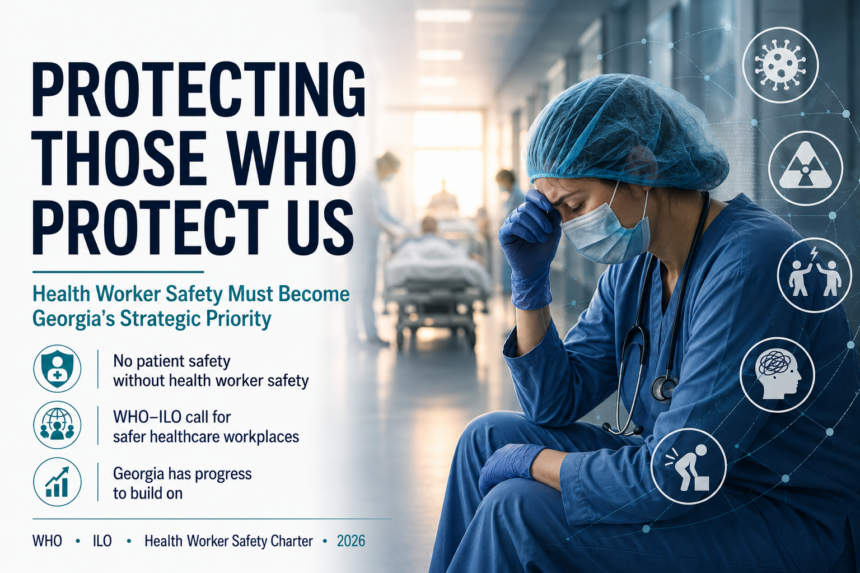
The lesson is one we should state plainly, because it reorganises everything that follows: there is no patient safety without health worker safety. A clinician who is infected, injured, sleep-deprived, or emotionally depleted does not deliver safer care — they deliver less of it, and with more error. Protecting health workers is not a question of staff welfare sitting somewhere off to the side of clinical quality. It is clinical quality. This is the central argument of the World Health Organization’s Health Worker Safety Charter, and it deserves to be the organising principle of how we think about our own system.

The world has already changed the rules
It is worth understanding how much the international ground has shifted, because it changes what is expected of every country, Georgia included. In June 2022 the International Labour Organization elevated its two core occupational safety and health conventions — Convention No. 155 and Convention No. 187 — to the status of fundamental instruments, placing a safe and healthy working environment alongside freedom from forced labour and child labour as a basic right at work. The practical consequence is that every ILO member state is now expected to respect and promote these principles and to report on its progress, whether or not it has formally ratified them. Occupational safety has moved from something a country may adopt to something it is obliged to pursue.
Around that core sits a coherent and increasingly demanding framework: Convention No. 161 on the establishment of preventive occupational health services; Convention No. 190, the first international treaty recognising everyone’s right to a working life free of violence and harassment, now in force; the joint WHO–ILO programme Caring for Those Who Care, which turns these standards into practical national programmes; and the WHO Global Strategy on Human Resources for Health, which treats decent and safe working conditions as inseparable from a sustainable workforce. The thread running through all of it is a single shift in thinking — from reacting to harm after it happens to preventing it before it does.
Georgia has built the foundation. Now comes the harder part.
Georgia’s progress over the past decade is real, and it deserves to be acknowledged rather than glossed over. Following the 2014 Association Agreement with the European Union, the country rebuilt its labour inspection function, adopted a Law on Labour Safety in 2018, and — most significantly — extended that law to all areas of economic activity from September 2019, requiring employers to maintain certified safety expertise and proper safety-management systems. According to the ILO, a further reform in 2020 broadened the inspectorate’s mandate beyond safety alone to the wider field of labour rights. This is a credible decade of work, and it should be recognised as such.
But here is where an editorial must be candid. A general occupational-safety law, applied uniformly across construction sites, factories, and hospitals, is a necessary foundation — and an insufficient one. The hazards of a hospital are specific: bloodborne and airborne infection, sharps injuries, cytotoxic drugs, radiation, the physical toll of moving patients, the psychological weight of the work. Protecting against these requires occupational health services built for the health sector — vaccination programmes, exposure monitoring, health surveillance, mental health support, and return-to-work pathways — not a one-size-fits-all compliance regime. The question facing Georgia is therefore not whether we have an occupational safety framework. We do. It is whether we have made that framework work for health workers specifically. On that, we have further to go.
Where the gaps remain
Occupational health services for health workers are still uneven across our facilities, in large part because responsibility for them falls awkwardly between health financing and labour regulation, belonging clearly to neither. Workplace violence against staff — verbal, intimidating, and at times physical — remains under-addressed, even though Convention No. 190 now offers a ready template for zero-tolerance policies and confidential reporting. Burnout is too often treated as an individual weakness rather than what it is: a system-generated occupational hazard produced by understaffing, excessive workload, and inadequate recovery time.
And beneath all of these sits the deepest problem — we do not measure any of it well. Georgia lacks comprehensive national data on occupational disease, injury, exposure incidents, and psychological harm among health workers. This is not a technical footnote. Without surveillance there is no feedback loop, no way to direct investment where it is needed, and no way to prove that protection pays for itself. If I were to identify a single highest-priority action, it would be this: build the data first. Everything else depends on it.
A vision worth committing to
Georgia is genuinely well-placed to become a regional leader in health worker safety, and the path is not mysterious. We should establish proper surveillance of occupational health in the sector, so that policy can be driven by evidence rather than assumption. We should build dedicated occupational health services for health workers in every facility. We should write staff safety, violence prevention, and worker wellbeing into our healthcare accreditation standards, so that protecting workers becomes a measured mark of a good hospital rather than an optional extra. And above all we should cultivate a culture in which prevention is simply how we work — not a box to be ticked for an inspector, but a habit embedded in everyday clinical practice.
The framing that WHO and ILO have offered the world is the right one for us to adopt: safe health workers, safe patients, strong health systems. Occupational safety and health is not an administrative burden to be discharged and forgotten. It is a strategic investment — in the quality of our care, the sustainability of our workforce, the safety of our patients, and the future of our health system. For Georgia, the next chapter should be the one in which we stop treating the safety of our health workers as a matter of compliance, and start treating it as a cornerstone of excellence.
Prof. Giorgi Pkhakadze (MD, MPH, PhD) Editor-in-Chief, Georgian Medical Journal Professor, David Tvildiani Medical University Chair, Public Health Institute of Georgia (PHIG)
Sources
- World Health Organization. Charter: health worker safety: a priority for patient safety. Geneva: WHO; 2020. https://www.who.int/publications/i/item/9789240011595
- World Health Organization, International Labour Organization. Caring for those who care: national programmes for occupational health for health workers (policy brief, 2021; implementation guide, 2022). https://www.who.int/publications/i/item/9789240040779
- International Labour Organization. Occupational Safety and Health Convention, 1981 (No. 155) — recognised as a fundamental Convention, June 2022. https://normlex.ilo.org/dyn/normlex/en/f?p=NORMLEXPUB:12100:0::NO::P12100_ILO_CODE:C155
- International Labour Organization. Promotional Framework for Occupational Safety and Health Convention, 2006 (No. 187) — recognised as a fundamental Convention, June 2022. https://normlex.ilo.org/dyn/normlex/en/f?p=NORMLEXPUB:12100:0::NO::P12100_ILO_CODE:C187
- International Labour Organization. Occupational Health Services Convention, 1985 (No. 161). https://normlex.ilo.org/dyn/normlex/en/f?p=NORMLEXPUB:12100:0::NO::P12100_ILO_CODE:C161
- International Labour Organization. Violence and Harassment Convention, 2019 (No. 190) — in force 25 June 2021. https://normlex.ilo.org/dyn/normlex/en/f?p=NORMLEXPUB:12100:0::NO::P12100_ILO_CODE:C190
- World Health Organization. Global strategy on human resources for health: workforce 2030. Geneva: WHO; 2016. https://www.who.int/publications/i/item/9789241511131
- World Health Organization. Global patient safety action plan 2021–2030. Geneva: WHO; 2021. https://www.who.int/publications/i/item/9789240032705
- International Labour Organization. Georgia’s Parliament adopts historic labour law reform package. 2020. https://www.ilo.org/resource/news/georgia%E2%80%99s-parliament-adopts-historic-labour-law-reform-package
- Organic Law of Georgia on Occupational Safety, 2018 (extended to all economic activity, 1 September 2019). https://matsne.gov.ge/en/document/view/4103880
Was this article helpful?