By using this site, you agree to the Privacy Policy and Terms of Use.
Accept
GMJ NewsGMJ NewsGMJ News
  • Latest News
    • GMJ Briefs
  • Podcast & Media
    • Podcast Episodes
    • GMJ Audio
    • GMJ Videos
  • Research Digest
    • New Studies
    • Georgian Research
    • Data & Numbers
  • Policy & Systems
    • Health Policy
    • Quality & Safety
    • Migration & Health
    • Global Health
  • Practice
    • Clinical Updates
    • Case Discussions
    • Pharmacy & Prescribing
    • Ingredients A-Z
  • Perspectives
    • Editorial
    • Explainers
    • Voices
    • Letters
  • GMJ Articles
    • Vol. 1 Issue 2 (2026)
    • Vol. 1 Issue 1 (2026)
    • Pre-Launch Articles (2025)
  • Read the Journal →
  • About GMJ News
Notification Show More
Font ResizerAa
GMJ NewsGMJ News
Font ResizerAa
  • Latest News
    • GMJ Briefs
  • Podcast & Media
    • Podcast Episodes
    • GMJ Audio
    • GMJ Videos
  • Research Digest
    • New Studies
    • Georgian Research
    • Data & Numbers
  • Policy & Systems
    • Health Policy
    • Quality & Safety
    • Migration & Health
    • Global Health
  • Practice
    • Clinical Updates
    • Case Discussions
    • Pharmacy & Prescribing
    • Ingredients A-Z
  • Perspectives
    • Editorial
    • Explainers
    • Voices
    • Letters
  • GMJ Articles
    • Vol. 1 Issue 2 (2026)
    • Vol. 1 Issue 1 (2026)
    • Pre-Launch Articles (2025)
  • Read the Journal →
  • About GMJ News
Follow US
GMJ News > Perspectives > Explainers > Heart’s First Beat Emerges From Collective Synchronisation, Not a Single ‘Starter Switch’
ExplainersNew StudiesPerspectivesResearch Digest

Heart’s First Beat Emerges From Collective Synchronisation, Not a Single ‘Starter Switch’

GMJ
Last updated: 12/07/2026 13:29
By
GMJ Perspectives Desk
Share
7 Min Read
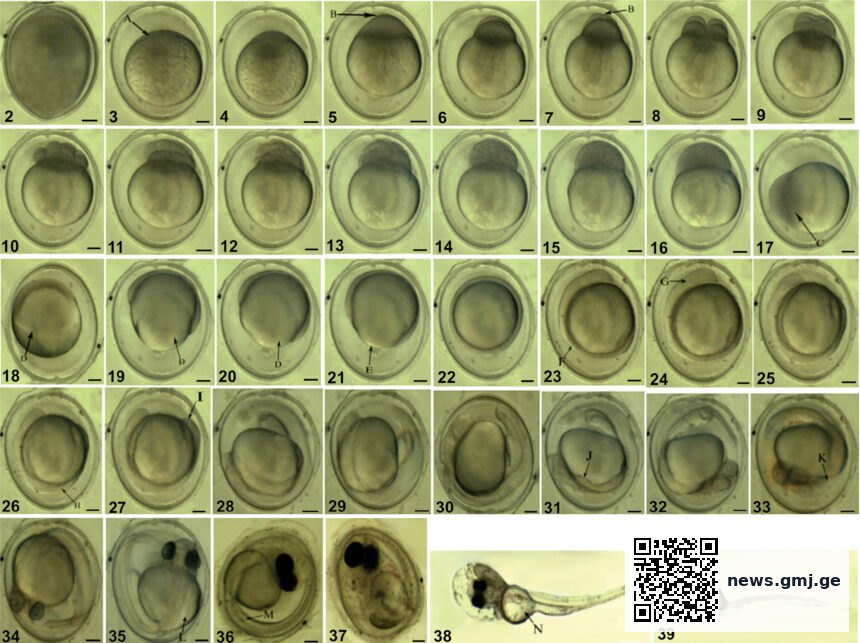
Diagram showing transition from individual electrically active heart cells to tissue-level synchronisation producing the first coordinated heartbeatIllustrative image · "Pseudorasbora parva (10.3897-zoologia.35.e22162) Figures 2–39" by Zhu D, Yang K, Sun N, Wang W, Zhou X (2018) Embryonic and larval development of the topmouth gudgeon, Pseudorasbora parva (Teleostei: Cyprinidae). Zoologia 35: 1-8. https://doi.org/10.3897/zoologia.35.e22162 is licensed under CC BY 4.0. To view a copy of this license, visit https://creativecommons.org/licenses/by/4.0/. (CC BY 4.0)
Scientists have identified that the heart's first beat emerges from collective electrical synchronisation of many cells crossing a critical threshold simultaneously, not from activation of a pre-existing pacemaker. The discovery, published in Nature (2023), reveals the initial heartbeat as a system-level phase transition—a fundamental example of emergence in biological tissue. — "Pseudorasbora parva (10.3897-zoologia.35.e22162) Figures 2–39" by Zhu D, Yang K, Sun N, Wang W, Zhou X (2018) Embryonic and larval development of the topmouth gudgeon, Pseudorasbora parva (Teleostei: Cyprinidae). Zoologia 35: 1-8. https://doi.org/10.3897/zoologia.35.e22162 is licensed under CC BY 4.0. To view a copy of this license, visit https://creativecommons.org/licenses/by/4.0/. (CC BY 4.0)
SHARE
4 min read|876 words
✓ Reviewed by Prof. Giorgi Pkhakadze, MD, MPH, PhD · ORCID 0000-0001-7609-4515

🟡 Preliminary Evidence

Contents
    • Key takeaways
      • From Silence to Rhythm: The Emergence Model of First Heartbeat Initiation
  • No Pre-Existing Pacemaker: A Paradigm Shift
  • Calcium Signalling and Irregular First Rhythms
  • Emergence: A System-Level Phase Transition in Living Tissue
    • What this means
  • Frequently asked questions
    • Does this discovery change how doctors treat heart rhythm problems in babies?
    • Why do the earliest heartbeats appear irregular?
    • Is this discovery relevant only to embryology, or does it apply to adult cardiac physiology?

The heart’s first beat does not ignite from a pre-built biological “starter switch” as previously assumed. Instead, research published in Nature (Jia et al., 2023) demonstrates that the initial heartbeat emerges as a sudden collective synchronisation event, when many developing heart cells cross a critical electrical threshold simultaneously and coordinate into a unified rhythm.

Key takeaways

  • The first heartbeat arises from collective electrical synchronisation of many heart cells, not from activation of a pre-existing pacemaker
  • Calcium-based electrical signals drive the earliest heartbeats, which are initially irregular but propagate across the developing heart tissue
  • The transition represents a system-level phase change—a fundamental example of emergence in biological tissue
1
Critical threshold event: when enough electrically active cells synchronise, the entire developing heart tissue coordinates its first beat instantaneously

From Silence to Rhythm: The Emergence Model of First Heartbeat Initiation

Transition from individual cell electrical activity to tissue-level synchronisation, based on Nature 2023

0
Coordinated heartbeats (initial state)
Threshold
Critical electrical activation level
1+
Synchronized tissue-level beat

Source: Jia et al., Nature, 2023 | Georgian Medical Journal News

Submit Your Paper
GMJ_Submit_Banner

No Pre-Existing Pacemaker: A Paradigm Shift

Classical cardiac embryology posited that a specialised group of cells—analogous to an electrical pacemaker—would spontaneously activate to trigger the first heartbeat. However, Jia et al.’s 2023 study in Nature reveals a fundamentally different mechanism. Rather than a discrete “switch,” the initiation of the first heartbeat involves a gradual increase in electrical activity across a distributed population of myocardial cells.

This finding challenges decades of developmental cardiac biology textbooks and redirects attention to new research paradigms in cardiac development. The authors documented that many cells slowly become electrically active in parallel, and when their collective activity crosses a critical threshold, the entire tissue synchronises instantaneously into a coordinated beat.

Calcium Signalling and Irregular First Rhythms

The earliest heartbeats are driven by calcium-based electrical signals propagating across the embryonic heart tissue, according to the Nature publication. Notably, these initial contractions are irregular and lack the steady rhythm of a mature heart—yet they already exhibit coordinated spread across the developing organ.

This calcium-mediated mechanism suggests that the fetal heart employs a distributed electrical system rather than relying on a hierarchical pacemaker-and-follower architecture. The implications extend to understanding how congenital arrhythmias might arise from failures in this collective synchronisation process, potentially opening new avenues for clinical intervention in cardiac developmental disorders.

Emergence: A System-Level Phase Transition in Living Tissue

What makes Jia et al.’s findings particularly significant is their recognition that the first heartbeat exemplifies emergence—a hallmark of complex systems where global order spontaneously arises from local interactions. The transition from complete electrical silence to coordinated rhythm is analogous to phase transitions in physics, such as liquid water suddenly crystallising into ice when temperature drops below a critical point.

This systems-level perspective has profound implications for developmental biology more broadly. It suggests that many organ systems may rely on similar emergence principles rather than centralised control mechanisms. Understanding these transitions at the cellular and tissue level could inform therapeutic strategies for diseases involving dysrhythmia and developmental failure.

The first heartbeat emerges as a system-level phase transition: instead of a pre-built pacemaker switching on, many heart cells gradually become electrically active until their collective synchronisation triggers a unified, coordinated beat.

— Jia et al., Nature (2023)

What this means

For patients: Understanding the true mechanism of heart formation may improve prenatal screening and early detection of congenital cardiac conditions, potentially enabling earlier intervention.
For clinicians: This collective synchronisation model shifts the diagnostic and therapeutic focus from seeking a single pacemaker malfunction to evaluating tissue-level electrical coherence and calcium signalling integrity in developmental arrhythmias.
For policymakers: Findings supporting fundamental paradigm shifts in cardiac development justify continued funding for basic developmental biology research, which underpins advances in prenatal medicine and congenital heart disease prevention.

Frequently asked questions

Does this discovery change how doctors treat heart rhythm problems in babies?

Not immediately, but it may guide future therapies. Current treatment of congenital arrhythmias focuses on symptom management; this understanding of collective synchronisation could eventually enable drugs or interventions targeting tissue-level electrical coordination rather than searching for a single malfunctioning pacemaker.

Why do the earliest heartbeats appear irregular?

According to Jia et al. (2023), irregularity in the first beats reflects the gradual, uneven electrical activation of scattered myocardial cells before system-wide synchronisation is fully established. As more cells coordinate, rhythmic stability improves.

Is this discovery relevant only to embryology, or does it apply to adult cardiac physiology?

While this study focuses on embryonic initiation, the principles of collective synchronisation and phase transitions may inform understanding of adult arrhythmias, particularly atrial fibrillation and other conditions involving loss of coordinated electrical activity across tissue regions.

The discovery that the heart’s first beat emerges from collective tissue synchronisation rather than a single biological switch represents a fundamental shift in developmental cardiac biology. As researchers continue to map the calcium signalling pathways and electrical thresholds governing this transition, the door opens to reimagining how developmental defects arise and how they might be prevented or corrected at the earliest stages of life. Further research into the molecular mechanisms underlying this phase transition may yield novel targets for improving outcomes in congenital heart disease.

Source: Jia et al., Nature, 2023

Was this article helpful?

Disclaimer. This article is health journalism intended for general information and education. It is not medical advice and is not a substitute for professional diagnosis or treatment. Always consult a qualified healthcare provider about your individual circumstances. Full disclaimer →

Related Coverage

How muscle movement clears blood glucose through a second pathway independent of insulinAug 2, 2026
Brain and Immune System Aging Emerge as True Lifespan Predictors in Major UK Biobank StudyAug 2, 2026
How a single dose of creatine protects cognitive function during sleep deprivationAug 2, 2026
How Vitamin D Becomes Active: The Three-Organ Pathway ExplainedAug 2, 2026
Related reference
  • Atrial Fibrillation · Condition
  • Calcium · Ingredient
PG
Written by
Prof. Giorgi Pkhakadze, MD, MPH, PhD
Editor-in-Chief, GMJ News
Full profile →  ·  ORCID 0000-0001-7609-4515
Medical disclaimer. This article is health journalism intended for general information. It is not medical advice and is not a substitute for consultation with a qualified healthcare professional. Always seek your physician's advice regarding any medical condition.
Medically reviewed by Prof. Giorgi Pkhakadze, MD, MPH, PhD. Spotted an error? Contact the editorial team.
Get the GMJ News digest
Evidence-based health journalism in your inbox. No spam; unsubscribe anytime.
TAGGED:calcium signallingcardiac physiologycollective behaviourembryonic developmentphase transition
Share This Article
Facebook LinkedIn Bluesky Copy Link Print
GMJ
ByGMJ Perspectives Desk
Follow:
GMJ Perspectives Desk is part of GMJ News, the newsroom of the Georgian Medical Journal (gmj.ge), published by the Public Health Institute of Georgia. Every article is editorially reviewed before publication.
Leave a Comment Leave a Comment

Leave a Reply Cancel reply

Your email address will not be published. Required fields are marked *

Submit Your Paper →

Georgia's peer-reviewed open-access medical journal. No APC until January 2027.
Submit Manuscript →
How muscle movement clears blood glucose through a second pathway independent of insulin

Muscle clears glucose through two pathways after meals: one insulin-dependent and one…

Brain and Immune System Aging Emerge as True Lifespan Predictors in Major UK Biobank Study

Only two of 11 organ-aging clocks independently predicted lifespan in 44,498 UK…

How a single dose of creatine protects cognitive function during sleep deprivation

A single high-dose oral creatine supplement preserved cognitive performance by up to…

Submit Your Paper to GMJ

No APC until January 2027.
Submit Manuscript →

You Might Also Like

Medical infographic showing GLP-1 medication reducing breast cancer risk statisticsPhoto by Angiola Harry on Unsplash (Unsplash License)
Clinical UpdatesNew StudiesPracticeResearch Digest

GLP-1 Weight-Loss Drugs Reduce Breast Cancer Risk by 17% in Largest Study to Date

By
GMJ Practice Desk
06/06/2026
Medical researchers analyzing breast cancer tissue samples in laboratory setting
New StudiesResearch Digest

First comprehensive study reveals genetic differences in Native American breast cancer

By
GMJ Research Desk
01/06/2026
Medical laboratory equipment and healthcare infrastructure representing gene therapy capabilities in AfricaIllustrative image · Photo by Roger Brown on Pexels (Pexels License)
New StudiesResearch Digest

Africa Needs Infrastructure Investment for Next-Generation Sickle Cell Therapies, BMJ Study Shows

By
GMJ Research Desk
21/06/2026
Healthcare workers providing mental health support after climate disaster
New StudiesResearch Digest

Mental health interventions show promise for extreme weather trauma recovery

By
GMJ Research Desk
29/05/2026
Facebook Twitter Youtube Instagram
Company
  • Privacy Policy
  • Contact US
  • GMJ Journal
  • Submit Manuscript
  • Editorial Team
  • Register at GMJ
  • Terms of Use

Subscribe to GMJ News — Click here

Join Community
© 2026 Georgian Medical Journal (GMJ). Published by the Public Health Institute of Georgia (PHIG). All rights reserved.
Welcome Back!

Sign in to your account

Username or Email Address
Password

Lost your password?

Not a member? Sign Up