
Photo: Tbilisi, by Geo Max (Flickr), cropped for layout · Licensed CC BY-SA 2.0 · Source
- Why a Country Needs Its Own Dictionary
- From a Notebook to an Institution
- January 2019: The First Release
- 2020–2022: What COVID-19 Revealed
- April 2026: A Journal, and a DOI
- What Makes This Dictionary the First of Its Kind
- The Nine-Step Staircase: How an Entry Is Actually Built
- Built to Be Navigated, Not Just Read
- A First Edition, Not a Final One
- Who Built It
- Explore the Dictionary
A feature on the flagship reference work of the Georgian Medical Journal — the story behind twenty years of work, told by the editorial team.
In 2006, in the library of the World Health Organization headquarters on Avenue Appia in Geneva, a Georgian public health physician wrote a single sentence in a notebook: “Georgia needs its own public health dictionary.” Not a translation of someone else’s work. Not an adaptation of a Russian Soviet-era glossary. An original — with Georgian examples, Georgian law, Georgian data, written for Georgian readers. Twenty years later, that sentence has become the Georgian Dictionary of Public Health (GDPH): 12,597 terms, 18 domains, the first comprehensive bilingual Georgian–English public health reference ever published.
Why a Country Needs Its Own Dictionary
At the time the idea was born, Georgian students of public health were learning epidemiology from English-language textbooks, often without knowing the Georgian equivalents of the very terms they were studying. Clinicians and policy-makers used inconsistent terminology across reports, legislation, and scientific papers. There was no authoritative Georgian source to settle the question of what a term actually meant, in Georgian, in a Georgian context. The gap wasn’t merely linguistic — it was epistemic: a field can’t fully develop its own thinking in a vocabulary borrowed wholesale from elsewhere.

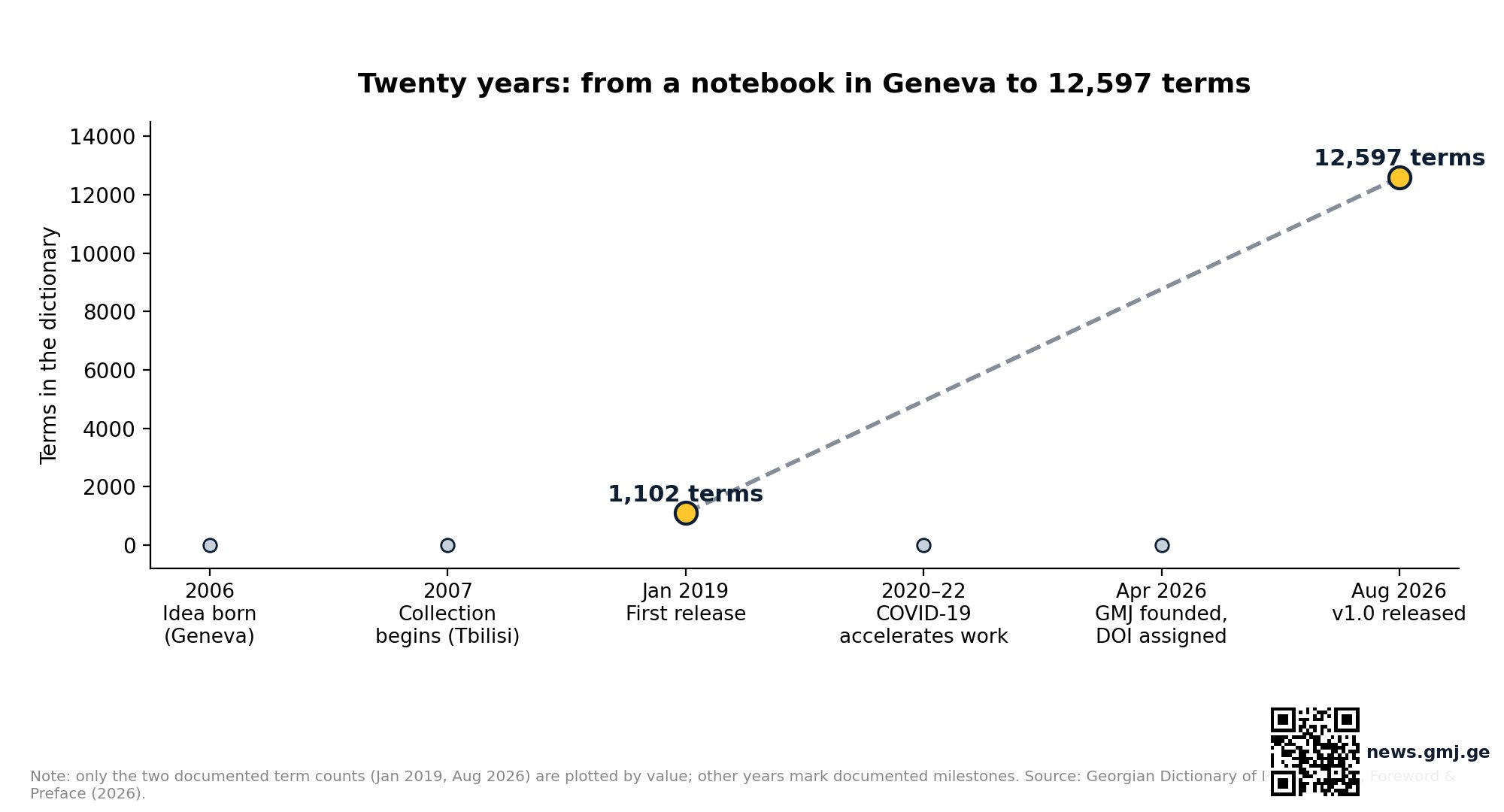
From a single notebook entry in Geneva to a 12,597-term reference work — the documented milestones of the GDPH’s twenty-year history.
From a Notebook to an Institution
When the idea’s author returned to Tbilisi in 2007 and joined David Tvildiani Medical University — later heading its School of Public Health — the notebook became a project. An open call went out to Georgian epidemiologists: send us your terms. What emerged was the ISI Glossary, named after its own database identifier, built through contributions from DTMU colleagues, from practising epidemiologists at Georgia’s National Centre for Disease Control, and from hospital physicians who had spent careers translating medical concepts for their patients in Georgian, one conversation at a time.
Over the following eleven years — 2008 to 2019 — terms were gathered, debated, and verified. This period produced the dictionary’s defining methodological choice: the nine-step staircase content model, developed specifically at DTMU’s School of Public Health, requiring every entry to carry not just a definition but a plain-language explanation, a genuinely Georgian everyday example, and an explicit statement of why the term matters for Georgian public health specifically. This was never conceived as a translation dictionary. It was built, from the outset, as an original reference work.
January 2019: The First Release
The ISI Glossary was publicly released for the first time in January 2019: 1,102 core terms, open access, bilingual Georgian–English — the first citable version of what would become the GDPH. It was, in the words of its editor, a beginning, not an end.
2020–2022: What COVID-19 Revealed
The COVID-19 pandemic exposed, with sudden and unforgiving force, exactly what the GDPH project had long understood: Georgia had no standardised public health vocabulary in its own language. Terms like incubation period, reproduction number, case fatality rate, and herd immunity were being rendered differently by different agencies, hospitals, and media outlets — creating real confusion at the worst possible moment, when clear public communication mattered most. During this period, the dictionary’s editor served as a principal public health adviser to the Prime Minister of Georgia and the Cabinet of Ministers, providing expert counsel on pandemic management, policy, and communication. That experience confirmed, beyond any doubt, that Georgia needed one authoritative Georgian-language public health reference — and that its absence had measurable consequences for national health governance. The dictionary’s development accelerated from that point on.
April 2026: A Journal, and a DOI
The Georgian Medical Journal was formally established in April 2026, with DOI prefix 10.66636 (Crossref member #56297). The dictionary was adopted as the journal’s flagship reference publication, and a systematic expansion began: the ICD-11 (WHO, 2024 release) contributed 10,673 terms; MeSH, the US National Library of Medicine’s subject heading system, contributed 318 selected headings; and a systematic legislative review of matsne.gov.ge, Georgia’s national legal database, anchored 141 terms directly to Georgian health law.
What Makes This Dictionary the First of Its Kind
The GDPH’s claim to being genuinely novel rests on a specific combination that, as far as its editorial team has been able to establish, has not existed before for the Georgian language: a comprehensive, bilingual, public-health-specific reference work, built from an original Georgian evidence base rather than a translated foreign dictionary, with terms directly anchored to Georgian national legislation, and covering the full breadth of the field — from epidemiology and biostatistics to bioethics, health economics, and the clinical–public-health boundary. Georgian medical dictionaries have existed before. A public-health-specific, law-anchored, bilingual reference work of this scope has not.
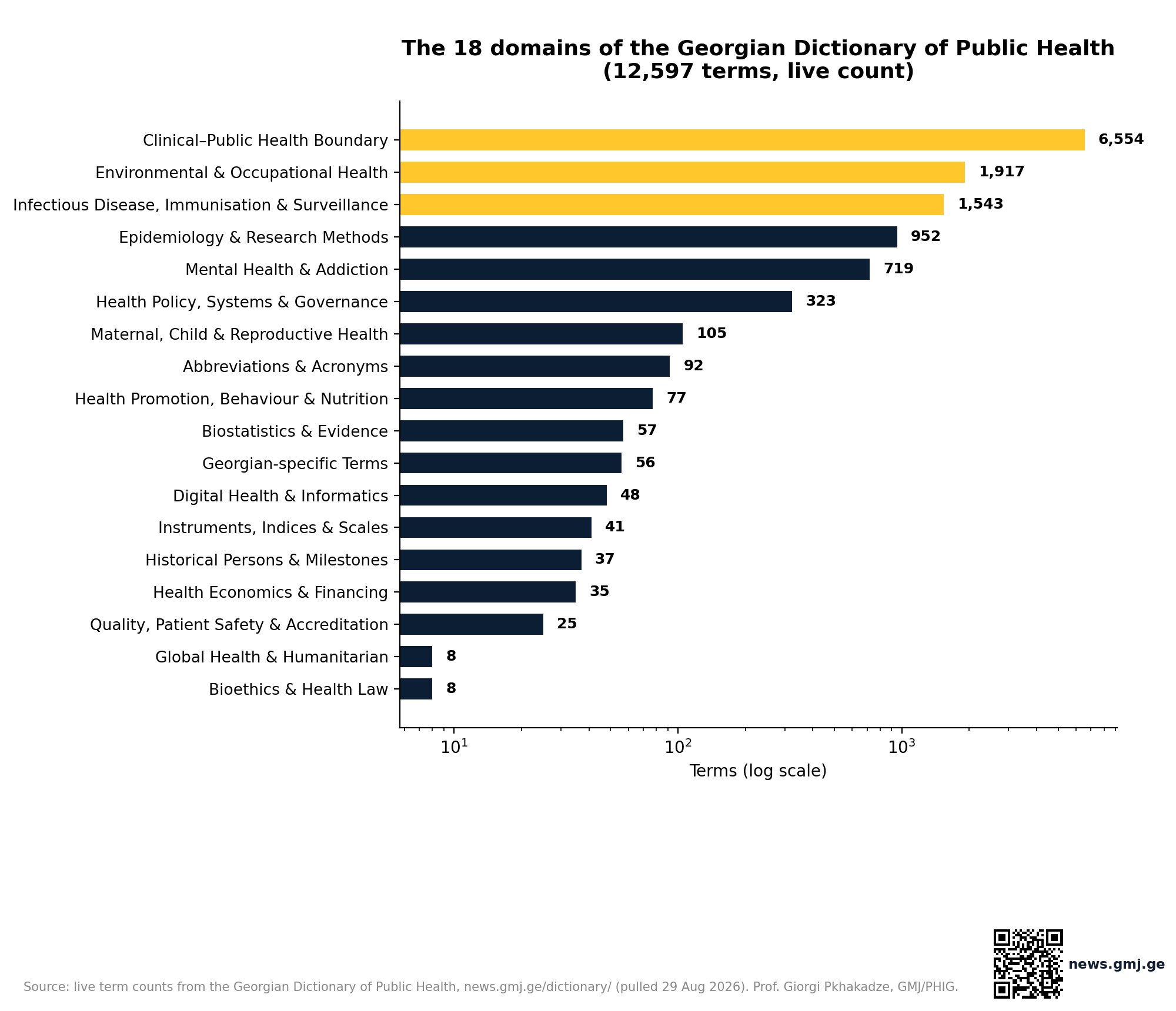
All 18 domains of the first electronic edition, by number of terms. Counts reflect the current live dictionary as of late August 2026. The Clinical–Public Health Boundary domain, built largely from the ICD-11 harvest, remains the largest by volume; Mental Health & Addiction and Environmental & Occupational Health have both grown substantially since the project’s early internal drafts, reflecting ongoing expansion work.
The full domain breakdown
| Domain | Terms (live) |
|---|---|
| Clinical–Public Health Boundary | 6,554 |
| Environmental & Occupational Health | 1,917 |
| Infectious Disease, Immunisation & Surveillance | 1,543 |
| Epidemiology & Research Methods | 952 |
| Mental Health & Addiction | 719 |
| Health Policy, Systems & Governance | 323 |
| Maternal, Child & Reproductive Health | 105 |
| Abbreviations & Acronyms | 92 |
| Health Promotion, Behaviour & Nutrition | 77 |
| Biostatistics & Evidence | 57 |
| Georgian-specific Terms | 56 |
| Digital Health & Informatics | 48 |
| Instruments, Indices & Scales | 41 |
| Historical Persons & Milestones | 37 |
| Health Economics & Financing | 35 |
| Quality, Patient Safety & Accreditation | 25 |
| Global Health & Humanitarian | 8 |
| Bioethics & Health Law | 8 |
| Total | 12,597 |
The Nine-Step Staircase: How an Entry Is Actually Built
Every GDPH entry is built to a defined structure, developed over the project’s eleven-year collection phase and formally approved by the editorial board as the standard for all entries:
- Headword — the English term, its Georgian translation, domain code, tier, and a flag if it’s anchored to Georgian law.
- Definition — a one-sentence, cited Georgian definition with an English parallel.
- Plain words — two to three sentences in plain Georgian, no jargon.
- Georgian example — a scene from Georgian daily life, not an abstract statistic.
- Why it matters — two to three sentences on the term’s practical importance.
- In depth — three to four paragraphs on the concept’s origin, scope, and measurement.
- Worked examples — drawing on both international and Georgian national context.
- See also — up to five cross-linked entries with page references.
- References — a minimum of three citations in Vancouver format.
Not every one of the 12,597 entries carries the full nine steps. The dictionary uses a tiered system: Tier A (163 terms) covers the core concepts every public health professional must know, with the complete staircase. Tier B (3,463 terms) covers important working vocabulary, also with full staircase content. Tier C (8,971 terms) — largely the clinical-boundary and ICD-11 terms — carries headword, Georgian translation, definition, and a minimum of three references, without the full worked-example depth.
Built to Be Navigated, Not Just Read
The dictionary’s 12,597 entries are cross-linked computationally: an inverted keyword index across every English headword generated 11,533 “See Also” links — reaching 91.6% of all entries — with a minimum relevance score enforced and a cap of five links per entry, so the connections stay genuinely useful rather than noisy. Six separate indices at the back of the printed edition give readers alternative routes into the same content: an alphabetical Georgian index (Mkhedruli script), an alphabetical English index, an ICD-11 code index (10,673 entries), a MeSH heading index (318 entries), a Georgian-law index (141 terms), and an index by domain.
A First Edition, Not a Final One
The GDPH’s editorial team is explicit that the First Edition is a technical dictionary — 12,597 terms with Georgian translations, domain classifications, tier designations, and standardised references — and that this alone represents the first time a bilingual public health terminology reference of this scope has existed in the Georgian language. But the project doesn’t end here. The online edition, hosted at news.gmj.ge/dictionary/, is open and collaborative: professionals, academics, students, and institutions are invited to contribute new terms, propose corrections, and flag terminology that has evolved.
A Second Edition is already in preparation, explicitly inspired by landmark reference works like Porta’s Dictionary of Epidemiology (Oxford University Press, 6th edition). Where the First Edition gives readers the term, the translation, and the structure, the Second Edition is planned to give the full explanation for every entry: detailed definitions in plain Georgian, rich worked examples drawn from Georgian public health practice, and comprehensive references throughout — extending the full nine-step staircase, currently reserved for Tier A and B terms, to the entire dictionary.
Who Built It
The GDPH is a collaborative work produced under the auspices of the Public Health Institute of Georgia (PHIG) and the Georgian Medical Journal (GMJ), with David Tvildiani Medical University (DTMU) as the project’s institutional home since 2008 and Georgia’s National Centre for Disease Control and Public Health (NCDC) contributing epidemiological surveillance terminology. It draws on five terminological sources: the WHO’s ICD-11 (10,673 terms), the US National Library of Medicine’s MeSH (318 terms), Porta’s Dictionary of Epidemiology as a structural model, Georgia’s national health legislation via matsne.gov.ge (141 terms), and the original ISI Glossary itself (1,102 founding terms). The whole work is licensed under Creative Commons Attribution 4.0 International, and published with ISSN 3088-4322 and DOI 10.66636/gmj.v1.i1.a201.
Explore the Dictionary
The full, searchable GDPH is freely available online.
🔤 Browse the Dictionary A–Z →
📖 About the Project →
✍️ Contribute a Term →
Official record: gmj.ge/index.php/pub/article/view/gdph · DOI: 10.66636/gmj.v1.i1.a201
How to cite the whole dictionary (APA):
Pkhakadze, G. (2026). Georgian Dictionary of Public Health (GDPH) — First Electronic Edition, Version 1.0: First Comprehensive Bilingual Georgian–English Public Health Terminology Reference. Georgian Medical Journal, 1(S1), 1–1036. https://doi.org/10.66636/gmj.v1.i1.a201
Georgian Medical Journal (GMJ) · ISSN 3088-4322 · gmj.ge · Open Access CC BY 4.0 · Published by the Public Health Institute of Georgia (PHIG). DOI: 10.66636/gmj.v1.i1.a201
Was this article helpful?
Disclaimer. This article is health journalism intended for general information and education. It is not medical advice and is not a substitute for professional diagnosis or treatment. Always consult a qualified healthcare provider about your individual circumstances. Full disclaimer →
Related Coverage


Editorial standards. This article was produced under the GMJ News editorial process, with oversight by the GMJ Editorial Board. Our editorial process. Spotted an error? Contact the editorial team.