
Updated 28/08/2026
Photo: Waiting room hospital, by Unknown · Public domain / CC0 · Source
Plain-language summary of research published in the Georgian Medical Journal. Written for the general public by the GMJ News editorial team.
A case-control dataset collected in Batumi between 2004 and 2006 sat unpublished for two decades. A study in the Georgian Medical Journal reanalyses it against 2026 clinical standards — creating a rare pre-treatment-era Georgian baseline for how multiple sclerosis affected mental health before disease-modifying therapies were widely available.

Why an Old Dataset Still Matters
Georgian evidence on psychiatric comorbidity in multiple sclerosis has always been sparse. This single-centre, hospital-based case-control study, conducted at the High Technology Hospital Medical Centre in Batumi, compared 30 adults with clinically confirmed MS against 30 age- and sex-matched healthy controls, using the Sheehan Patient-Rated Anxiety Scale plus structured interviews covering panic frequency, daily functioning, social behaviour, and suicidal ideation.
What the Data Showed
The gap between groups was stark. Any panic attacks (five or more per month) were reported by 86.7% of MS patients versus 56.7% of controls — nearly five times higher odds. Patients also had significantly higher odds of impaired daily functioning, capability changes, and social-behaviour disturbance. Suicidal ideation was more than twice as common in the MS group (36.7% vs 13.3%).
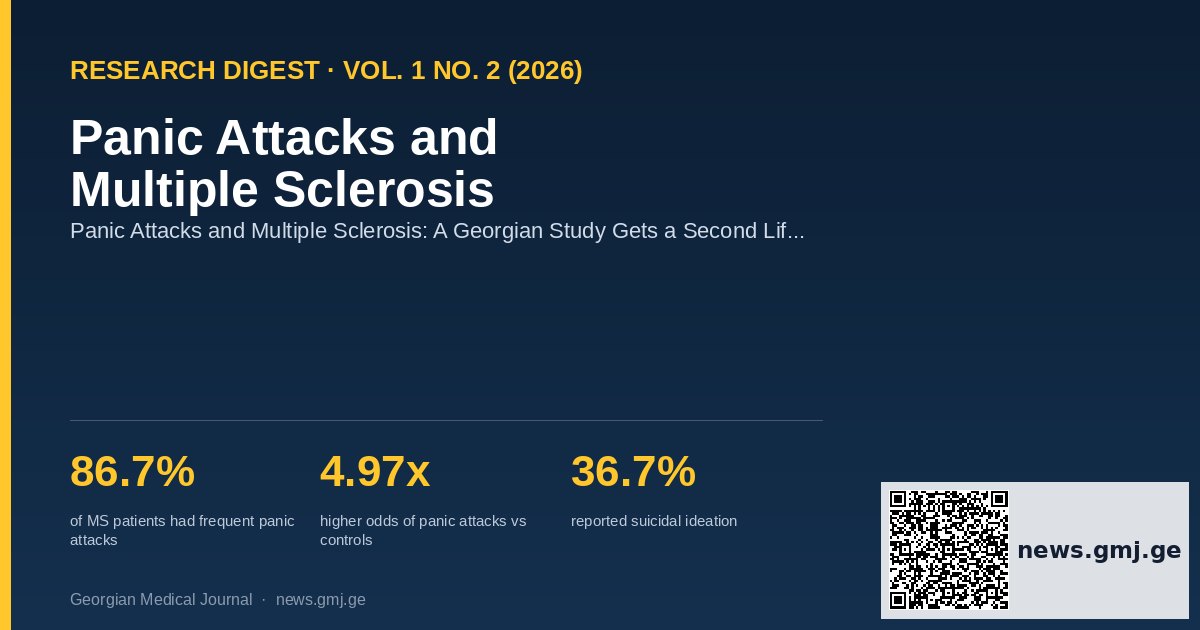
At a glance — the headline figures.
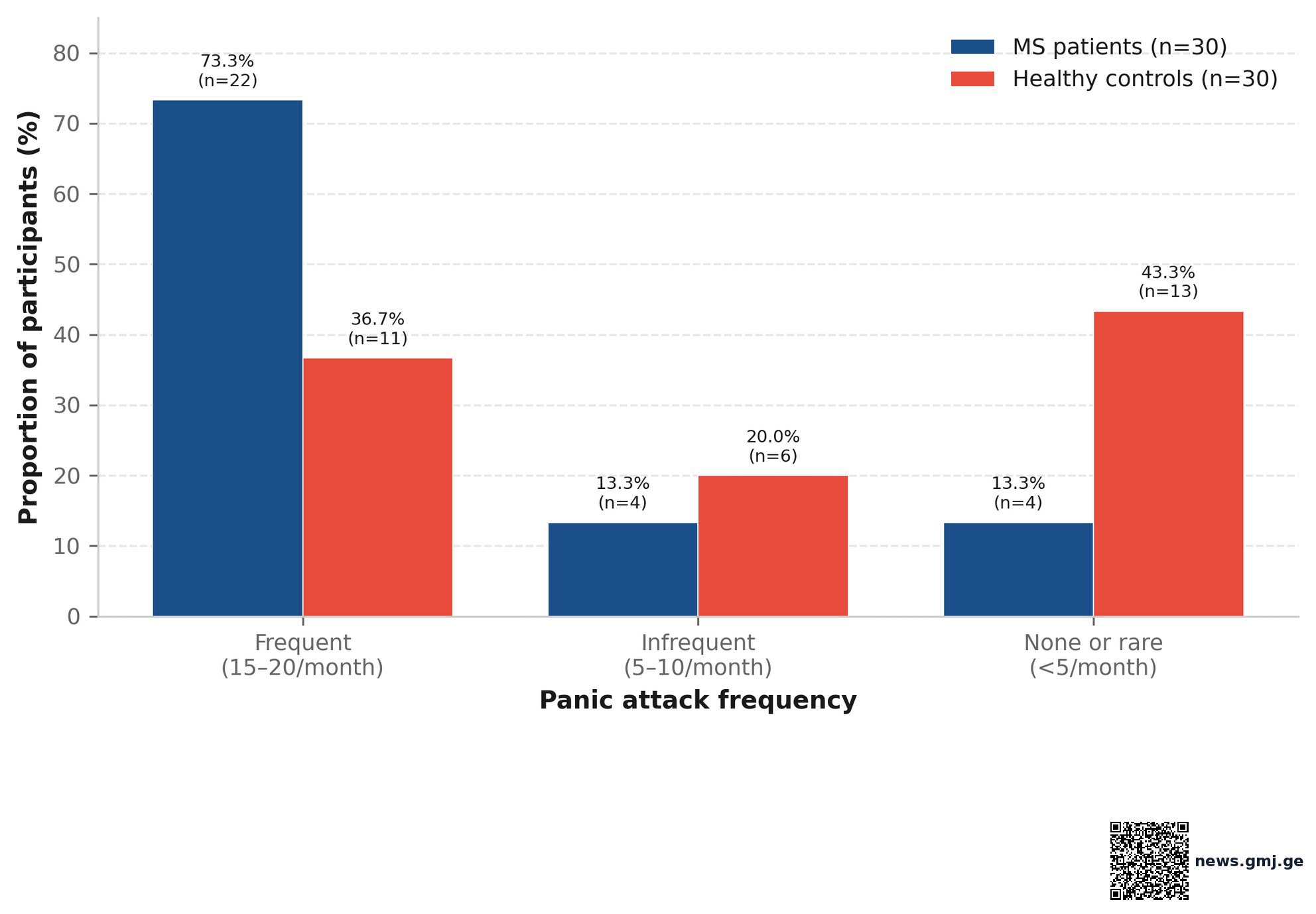
Panic-attack frequency and psychiatric symptom prevalence, MS patients versus matched healthy controls. Figure from the study. Source: Georgian Medical Journal, Vol. 1 No. 2 (2026), DOI: 10.66636/gmj.v1.i2.a111.
The authors read this reanalysis as a benchmark, not just a historical curiosity: this magnitude of psychiatric burden plausibly reflects what MS looked like when lived in the near-total absence of modern disease-modifying care. That gives contemporary Georgian MS treatment something concrete to be measured against — and the paper argues it strengthens the case for integrated psychiatric screening, expanded treatment access, and a proper contemporary multicentre Georgian MS registry going forward.
Read the Original Research
Original article: Panic Attacks and Multiple Sclerosis: A Georgian Study Gets a Second Life
Published in: Georgian Medical Journal, Vol. 1 No. 2 (2026)
DOI: 10.66636/gmj.v1.i2.a111
📄 Read the full article at gmj.ge →
Georgian Medical Journal (GMJ) · ISSN 3088-4322 · gmj.ge · Open Access CC BY 4.0 · Published by the Public Health Institute of Georgia (PHIG). This summary is an independent editorial product of GMJ News; for clinical decisions, consult the original peer-reviewed article and a qualified professional.
Was this article helpful?
Disclaimer. This article is health journalism intended for general information and education. It is not medical advice and is not a substitute for professional diagnosis or treatment. Always consult a qualified healthcare provider about your individual circumstances. Full disclaimer →
Related Coverage




Editorial standards. This article was produced under the GMJ News editorial process, with oversight by the GMJ Editorial Board. Our editorial process. Spotted an error? Contact the editorial team.