Pan American Health Organization · Version 1, 2020
Operational guidance for maintaining vaccination services as essential primary care across four COVID-19 transmission phases.
- Issuer
- Pan American Health Organization
- Edition
- Version 1, 2020
- Audience
- Primary care teams, immunization programme managers at national and sub-national levels, first-level care facility managers
- Evidence
- Expert consensus based on WHO/PAHO technical documents
- Reviewed
- 20 Oct 2026 · GMJ
What this guideline says
GMJ summary
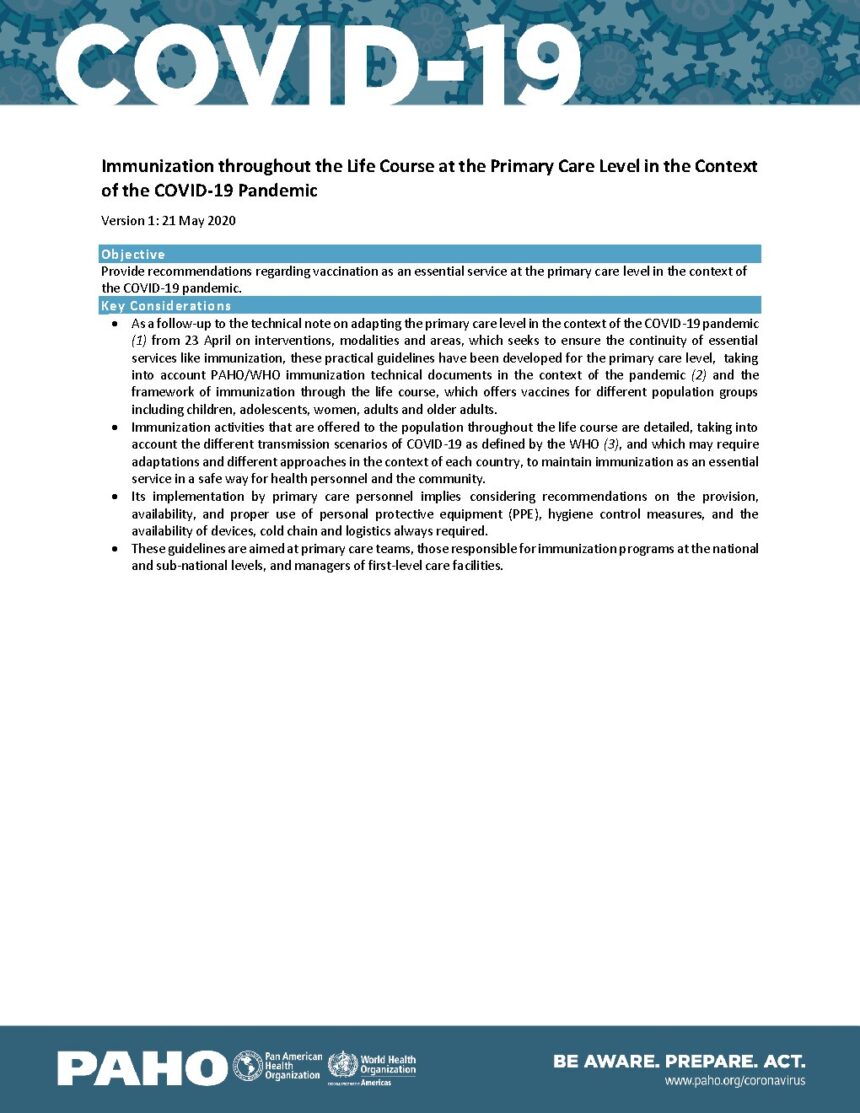
This operational guideline provides practical recommendations for maintaining immunization services at the primary care level during the COVID-19 pandemic. It stratifies activities according to four WHO-defined transmission phases: no cases, sporadic cases, case clusters, and community transmission.
The guideline addresses institutional vaccination, mobile posts, at-home vaccination, community vaccination in outbreak response, vaccination of health personnel, and epidemiological surveillance. Key principles include physical separation of vaccination areas from COVID-19 care areas, appointment scheduling to reduce crowding, prioritization of vaccine-preventable diseases with outbreak potential (measles, polio, diphtheria, influenza, yellow fever), and protection of health personnel through proper PPE and infection control measures.
The framework emphasizes that immunization remains an essential service throughout the pandemic, with adaptations required based on local transmission intensity. In phase 4 (community transmission), certain activities such as mobile posts and community campaigns are suspended, but institutional vaccination continues for spontaneous attendees with priority given to newborn vaccination and diseases with outbreak potential.
Key points
For clinicians — doses and thresholds as stated in the guideline
- Maintain routine institutional vaccination in all phases, with appointment scheduling introduced from phase 2 onwards to reduce crowding and enable social distancing measures
- Physically separate vaccination areas from healthcare services for COVID-19 patients, ideally relocating vaccination posts outside areas where patients are received to reduce contagion risk
- Prioritize vaccine-preventable diseases with outbreak potential: measles, polio, diphtheria, influenza, and yellow fever across all phases
- In phase 4 (community transmission), prioritize newborn vaccination plus measles, polio, diphtheria, influenza, and yellow fever vaccination
- Suspend mobile post vaccination and at-home vaccination activities during phase 4 until SARS-CoV-2 transmission risk is lowered and health system capacity recovers
- Suspend community vaccination campaigns during phases 3 and 4 until epidemiological conditions improve and health system capacity recovers
- Vaccinate health personnel according to national schedule, prioritizing influenza and measles/rubella vaccination across all phases
- Monitor DTP3 vaccination coverage at sub-national levels with special attention to vulnerable groups (indigenous, displaced populations) throughout all phases
Immunization throughout the Life Course during the COVID-19 Pandemic
Table extracted from the guideline
| Component | Phase 1: No cases | Phase 2: Sporadic cases | Phase 3: Case clusters | Phase 4: Community transmission |
|---|---|---|---|---|
| Institutional vaccination | Maintain routine vaccination; prepare physical environments; use PPE and social distancing | Schedule appointments; physical separation of areas; prioritize outbreak-prone diseases (measles, polio, diphtheria, influenza, yellow fever) | Schedule appointments with special sessions for older adults and chronic disease patients; physical separation; prioritize outbreak-prone diseases | Vaccinate spontaneous attendees; prioritize newborn, measles, polio, diphtheria, influenza, yellow fever; physical separation |
| Mobile posts (outside health units) | Continue per national schedule with infection control and physical distancing | Continue per national schedule with infection control and PPE | Continue with prioritization of outbreak-prone diseases | Suspend until SARS-CoV-2 transmission lowered and system capacity recovered |
| At-home vaccination | Identify unvaccinated; prioritize outbreak-prone diseases (measles, polio, diphtheria, influenza, yellow fever) | Identify unvaccinated; prioritize outbreak-prone diseases; use health personnel protection | Evaluate convenience based on epidemiological conditions; identify unvaccinated; prioritize outbreak-prone diseases | Suspend until SARS-CoV-2 transmission lowered and system capacity recovered |
| Community vaccination (outbreak response/campaigns) | Maintain per national guidelines | Community vaccination in affected zones for outbreak-prone diseases | Evaluate convenience based on epidemiological conditions | Suspend until SARS-CoV-2 transmission lowered and system capacity recovered |
| Health personnel vaccination | Per national schedule, prioritizing influenza and measles/rubella | Per national schedule, prioritizing influenza and measles/rubella | Per national schedule, prioritizing influenza and measles/rubella | Per national schedule, prioritizing influenza and measles/rubella |
| Monitoring | DTP3 coverage at sub-national level, vulnerable groups (indigenous, displaced); supplies and cold chain | DTP3 coverage at sub-national level, vulnerable groups; supplies and cold chain | DTP3 coverage at sub-national level, vulnerable groups; supplies and cold chain | DTP3 coverage at sub-national level, vulnerable groups; supplies and cold chain |
Source: Pan American Health Organization, Immunization throughout the Life Course at the Primary Care Level in the Context of the COVID-19 Pandemic. Reproduced in summary form.
From the guideline
Verbatim
“Immunization activities that are offered to the population throughout the life course are detailed, taking into account the different transmission scenarios of COVID-19 as defined by the WHO, and which may require adaptations and different approaches in the context of each country, to maintain immunization as an essential service in a safe way for health personnel and the community.”
Editor’s perspective
Why this matters for Georgia and the region
Prof. Giorgi Pkhakadze, MD, MPH, PhD
Editor-in-Chief, Georgian Medical Journal · Chair, Public Health Institute of Georgia · WHO consultant, health and migration
As Georgia navigated COVID-19 in 2020, maintaining immunization coverage was critical to prevent resurgence of measles and other vaccine-preventable diseases that had been well controlled through our national programme. This PAHO guidance provided a practical framework that many countries, including in our region, adapted for local use. The phase-stratified approach is particularly valuable because it gives clear operational guidance rather than simply declaring immunization 'essential' without explaining how to deliver it safely. For Georgian primary care teams, I would emphasize the recommendation to physically separate vaccination services from COVID care areas—in our small rural ambulatories, this often meant setting up outdoor or separate entrance vaccination posts. The realistic caveat is that the guidance assumes adequate PPE supplies, trained personnel, and functioning cold chains, all of which were strained during 2020; programmes must address these prerequisites before implementing the operational recommendations, otherwise health workers face unacceptable risks and public confidence in vaccine safety erodes.
ORCID 0000-0001-7609-4515 · Perspective written for the GMJ Guidelines Library, 20 Oct 2026
Applicability
Georgia and the South Caucasus
This guidance is directly applicable to Georgia and the South Caucasus region, where primary care networks form the backbone of immunization delivery. Georgian programmes would need to adapt recommendations to the national immunization schedule, which includes vaccines not universally mentioned (BCG, hepatitis B, rotavirus, pneumococcal conjugate). The emphasis on vulnerable populations (indigenous, displaced) is particularly relevant for the region given internal displacement issues and diverse ethnic communities. National programmes should define thresholds for transitioning between phases based on local COVID-19 epidemiology, ensure PPE availability at primary care facilities including rural health posts, and strengthen communication to maintain public trust in vaccination during pandemic conditions. The cold chain monitoring recommendations are critical for the Caucasus region’s geographic and climatic diversity.
Questions this guideline answers
Quick answers
Should routine vaccination services continue during COVID-19 community transmission?
Yes, institutional vaccination should continue even in phase 4 (community transmission) for people who spontaneously attend health services, with priority given to newborn vaccination and vaccines against measles, polio, diphtheria, influenza, and yellow fever. Physical separation from COVID-19 care areas and PPE use are essential.
When should mobile vaccination posts and at-home vaccination be suspended?
Mobile posts and at-home vaccination should be suspended during phase 4 (community transmission) until the risk of SARS-CoV-2 transmission has been lowered and health system capacity has recovered sufficiently to resume these activities safely.
Which vaccines should be prioritized during the pandemic?
Prioritize vaccine-preventable diseases with potential for outbreaks: measles, polio, diphtheria, influenza, and yellow fever. In phase 4, also prioritize newborn vaccination. Health personnel should receive influenza and measles/rubella vaccination across all phases.
How should vaccination areas be organized to reduce COVID-19 transmission risk?
Physically separate vaccination areas from healthcare services where COVID-19 patients are received, ideally relocating vaccination posts outside these areas. Use appointment scheduling from phase 2 onwards to reduce crowding, with special sessions for older adults and those with chronic diseases. Implement social distancing measures and ensure proper PPE use.
Related on GMJ
Interconnected resources
Dictionary of Public Health
GMJ News coverage
- UK flu and COVID-19 surveillance data to May 2027 shows continued monitoring amid seasonal trendsOct 2026
- Community Health Workers Boost COVID-19 Testing Among Formerly Incarcerated PeopleAug 2026
- The Pennsylvania Measles Deaths Are a Failure of Will, Not EpidemiologyOct 2026
- Bangladesh's Measles Crisis: How a Vaccination Success Turned Into 120,000 CasesOct 2026
Quality & accreditation
- ASF PHC — Standard 4 — Acute & Same-Day Care · Primary Health Clinic
- ASF PHC — Standard 7 — Governance & Staffing · Primary Health Clinic
- ASF Hospital — Standard 5 — Safety & Emergency Preparedness
- ASF Medical Transport — Standard 5 — Infection Prevention & Control
- ASF Laboratory — Standard 7 — Examination: Process & Safety
Other guidelines on this topic
- Retrofit Measures for COVID-19
- Summary on Advances in the Development of Vaccines against COVID-19, 3 April 2020
- COVID-19 Recommendations: Prehospital Emergency Medical Services (EMS)
- Recommendations on Public Environmental Health in Health Care Facilities
- A Checklist for COVID-19 Pandemic Risk and Impact Management
- Issuer
- Pan American Health Organization
- Type
- Procedures, manuals, guidelines
- Edition
- Version 1, 2020
- Status
- Current
- Published
- 2020-01-01
- Scope
- Primary care level immunization services
- Audience
- Primary care teams, immunization programme managers at national and sub-national levels, first-level care facility managers
- Licence
- CC BY-NC-SA 3.0 IGO
- Evidence
- Expert consensus based on WHO/PAHO technical documents
- Record history
- Created 20 Oct 2026 · updated 20 Oct 2026 · next check Apr 2027
Pan American Health Organization. Immunization throughout the Life Course at the Primary Care Level in the Context of the COVID-19 Pandemic, Version 1: 21 May 2020. Washington, D.C.: PAHO; 2020. Available from: https://iris.paho.org/handle/10665.2/52291GMJ Guidelines Library records are original summaries written by the GMJ editorial team from the issuer’s published document and reviewed by a physician. They do not replace the full guideline. The document is the copyright of its issuer and is linked, not hosted. Spotted an error or a newer edition? Tell the Guidelines Desk.
Was this article helpful?