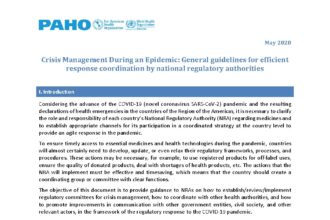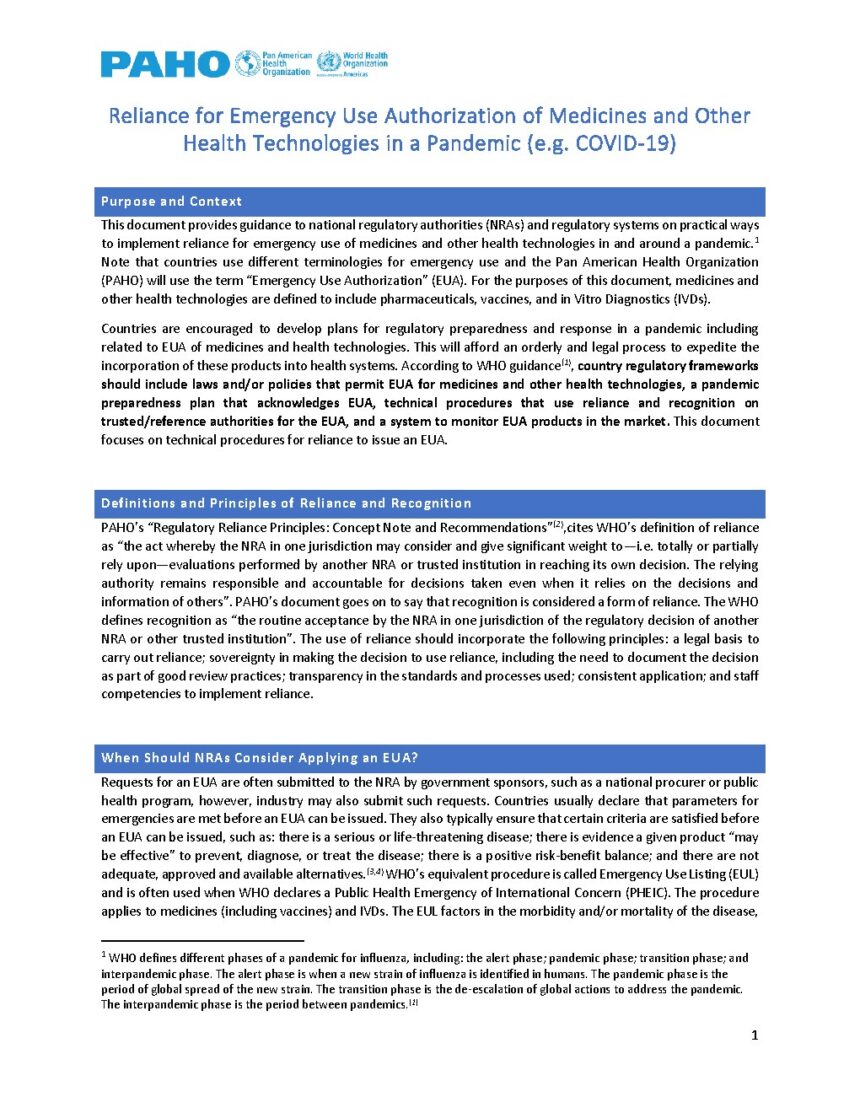
Pan American Health Organization · 1st edition, 2020
Guidance for national regulatory authorities on implementing reliance procedures for emergency use authorization of medicines, vaccines and diagnostics during pandemics.
- Issuer
- Pan American Health Organization
- Edition
- 1st edition, 2020
- Audience
- National regulatory authorities, regulatory systems, government sponsors, public health programmes
- Evidence
- Expert consensus based on WHO regulatory frameworks and pandemic preparedness guidance
- Reviewed
- 20 Oct 2026 · GMJ
What this guideline says
GMJ summary
This PAHO guidance document provides national regulatory authorities (NRAs) with a practical framework for implementing reliance-based procedures to expedite emergency use authorization (EUA) of medicines, vaccines and in vitro diagnostics during pandemic situations. The document addresses countries with varying regulatory capacity, acknowledging that many NRAs lack the staff or expertise to conduct full reviews of clinical data in emergency circumstances.
The core recommendation is for NRAs to rely on decisions made by trusted or reference regulatory authorities rather than conducting full or abridged reviews themselves. The guidance outlines criteria for when EUA should be considered: a serious or life-threatening disease exists, evidence suggests a product “may be effective”, there is a positive risk-benefit balance, and no adequate approved alternatives are available. Key technical requirements focus on verification of product sameness, manufacturing information, labelling in national languages, and post-market surveillance commitments.
The document emphasises that reliance does not abdicate responsibility—the NRA remains accountable for its decisions even when relying on others’ evaluations. It provides practical annexes including lists of WHO reference authorities for IVDs, templates for cover letters and approval documentation, and a matrix of requirements differentiated by product category (pharmaceuticals, vaccines, IVDs).
Key points
For clinicians — doses and thresholds as stated in the guideline
- EUA criteria: serious/life-threatening disease, evidence product "may be effective", positive risk-benefit balance, and no adequate approved alternatives available
- NRAs should rely on trusted/reference authorities (WHO listed authorities, stringent regulatory authorities, regional reference NRAs) rather than conduct full reviews in emergencies
- Essential documentation: cover letter confirming product sameness, EUA certificate from reference authority, Summary of Product Characteristics, finished product release specifications, GMP certification (or ISO 13485 for IVDs), and complete labelling artworks in national language
- Supplemental quality, non-clinical and clinical documentation (ICH CTD Module 2 summaries) is not recommended during emergencies as preparation causes delays
- EUA validity is limited to the declared emergency period and should be monitored on a daily basis for changing circumstances
- Post-market surveillance required: maintain lot deployment records, implement national surveillance plan, report adverse events through established pharmacovigilance/substandard-falsified medicine systems
- For designated higher-risk products, suppliers must provide Risk Management Plan and Periodic Safety Update Reports when available from the reference authority
- Multiple reference authority approvals should be awaited before EUA issuance to avoid circumstances that may uniquely influence individual authority decisions—a prudent approach
Summary of Requirements for Different Product Categories
Table extracted from the guideline
| Requirement | Pharmaceutical | Vaccine | In Vitro Diagnostic (IVD) |
|---|---|---|---|
| Assurance of Sameness | Cover letter; EUA or marketing authorization certificate | Cover letter; EUA or marketing authorization certificate | Cover letter; EUA or marketing authorization certificate |
| Product Description | Summary of Product Characteristics, product monograph or equivalent, package insert/prescribing information; Finished product release specifications | Summary of Product Characteristics, product monograph or equivalent, package insert/prescribing information; Finished product release specifications | Variants and configurations |
| Manufacturing Information | List of all sites involved in manufacturing process; Certification of FPP GMP accepted by trusted/reference authority | List of all sites involved in manufacturing process; Certification of FPP GMP accepted by trusted/reference authority | List of all sites involved in manufacturing process; ISO 13485 certificate |
| Product Labeling | PDF artworks including labelling, primary/secondary packaging, and product leaflet | PDF artworks including labelling, primary/secondary packaging, and product leaflet | PDF artworks including labelling, primary/secondary packaging, and any informational inserts |
| Post Market Surveillance | Copy of Risk Management Plan and Vigilance Report (e.g. PSUR/PBRER) when available; Report to PV/SF surveillance system if problems | Copy of Risk Management Plan and Vigilance Report (e.g. PSUR/PBRER) when available; Report to PV/SF surveillance system if problems | Report to PV/SF surveillance system if problems |
Source: Pan American Health Organization, Reliance for Emergency Use Authorization of Medicines and Other Health Technologies in a Pandemic (e.g. COVID-19). Reproduced in summary form.
From the guideline
Verbatim
“It is critical that NRAs focus their resources in ensuring that the same product is being authorized in both the NRA and the trusted/reference authority.”
Editor’s perspective
Why this matters for Georgia and the region
Prof. Giorgi Pkhakadze, MD, MPH, PhD
Editor-in-Chief, Georgian Medical Journal · Chair, Public Health Institute of Georgia · WHO consultant, health and migration
This PAHO guidance offers Georgia a pragmatic regulatory pathway that acknowledges our limited capacity for full product evaluation whilst maintaining accountability for public health decisions. During COVID-19, we witnessed the consequences of both delayed access to essential medical products and the risks of unregulated importation; this framework addresses both concerns through structured reliance on WHO and stringent regulatory authorities. For Georgian regulatory bodies, I would emphasise the critical requirement to verify product sameness—manufacturers sometimes produce different-quality products for different markets, including 'for export only' formulations, so documentation confirming identical specifications between the reference authority approval and the Georgian submission is non-negotiable. The realistic implementation challenge for Georgia and neighbouring countries will be establishing robust post-market surveillance systems with functional pharmacovigilance reporting; without this capacity to detect safety signals after authorization, the reliance framework loses its accountability foundation and public trust erodes rapidly.
ORCID 0000-0001-7609-4515 · Perspective written for the GMJ Guidelines Library, 20 Oct 2026
Applicability
Georgia and the South Caucasus
This guidance is directly applicable to Georgia as the country works to strengthen its regulatory framework for emergency preparedness, particularly following COVID-19 experience. Georgia’s National Center for Disease Control and Public Health and the relevant regulatory bodies would benefit from establishing formal reliance procedures with WHO, EMA and other stringent regulatory authorities. The guidance is especially relevant for the South Caucasus and Eastern Europe region where many countries have limited regulatory capacity for full product evaluation but need rapid access to pandemic countermeasures. National programmes should consider: establishing legal frameworks that permit EUA, developing formal policies identifying which authorities will serve as reference points (WHO prequalification, EMA, FDA, or regional authorities), training staff in reliance procedures, and strengthening pharmacovigilance systems to monitor emergency-authorised products. The requirement for labelling in national languages (Georgian, Armenian, Azerbaijani) while maintaining product sameness is a practical consideration that balances local needs with regulatory efficiency.
Questions this guideline answers
Quick answers
What is the difference between reliance and recognition in regulatory practice?
Reliance is when a regulatory authority considers and gives significant weight to evaluations performed by another authority whilst remaining responsible for its own decision. Recognition is a form of reliance involving routine acceptance of another authority's regulatory decision. In both cases, the relying authority remains accountable for decisions taken.
Which regulatory authorities should be considered trusted references for emergency use authorization?
WHO recommends its listed authorities based on Global Benchmarking Tool evaluations, WHO prequalification for medicines and Emergency Use Listing, and for IVDs specifically: FDA (USA), Health Canada, TGA (Australia), MHLW (Japan), and HSA (Singapore). In the Americas, PAHO designates National Regulatory Authorities of Regional Reference including Argentina, Brazil, Canada, Chile, Colombia, Cuba, Mexico and the United States.
Do we need to review full clinical trial data when using reliance for emergency authorization?
No. PAHO/WHO recommends NRAs expedite reviews and use reliance procedures rather than conduct full or abridged reviews. Requesting ICH Common Technical Document Module 2 summaries or detailed non-clinical and clinical information is not recommended during emergencies as preparation causes unnecessary delays. The focus should be on verifying product sameness and documentation from the reference authority.
How long does an emergency use authorization remain valid?
EUA is only valid during the time of declared emergency and should be monitored on a daily basis for changing circumstances. The approval is specific to the pandemic period. Post-market surveillance must continue throughout this period, with updates as additional information is received from manufacturers concerning the full product lifecycle.
Related on GMJ
Interconnected resources
Dictionary of Public Health
GMJ News coverage
- UK flu and COVID-19 surveillance data to May 2027 shows continued monitoring amid seasonal trendsOct 2026
- Community Health Workers Boost COVID-19 Testing Among Formerly Incarcerated PeopleAug 2026
- Generic Flu Antivirals Won't Save Us Unless Rich Nations Commit to Using ThemSep 2026
- UNICEF warns of devastating toll on children in armed conflict zones across globeSep 2026
Quality & accreditation
Other guidelines on this topic
- Ethics guidance for the use of scarce resources in the delivery of critical health care during the COVID-19 pandemic
- Ongoing Living Update of Potential COVID-19 Therapeutics: Summary of Rapid Systematic Reviews
- An Overview of Current Social Distancing Measures and Required Evidence for Determining Optimal Time for Relaxing Such Measures
- Enhancing COVID-19 Mortality Surveillance in Latin America and the Caribbean through All-Cause Mortality Surveillance
- COVID-19: Chloroquine and hydroxychloroquine research
- Issuer
- Pan American Health Organization
- Type
- Procedures, manuals, guidelines
- Edition
- 1st edition, 2020
- Status
- Current
- Published
- 2020-01-01
- Languages
- English
- Scope
- Global, with focus on countries with limited regulatory capacity
- Audience
- National regulatory authorities, regulatory systems, government sponsors, public health programmes
- Licence
- CC BY-NC-SA 3.0 IGO
- Evidence
- Expert consensus based on WHO regulatory frameworks and pandemic preparedness guidance
- Record history
- Created 20 Oct 2026 · updated 20 Oct 2026 · next check Apr 2027
Pan American Health Organization. Reliance for Emergency Use Authorization of Medicines and Other Health Technologies in a Pandemic (e.g. COVID-19). Washington, D.C.: PAHO; 2020. Available from: https://iris.paho.org/handle/10665.2/52027GMJ Guidelines Library records are original summaries written by the GMJ editorial team from the issuer’s published document and reviewed by a physician. They do not replace the full guideline. The document is the copyright of its issuer and is linked, not hosted. Spotted an error or a newer edition? Tell the Guidelines Desk.
Was this article helpful?