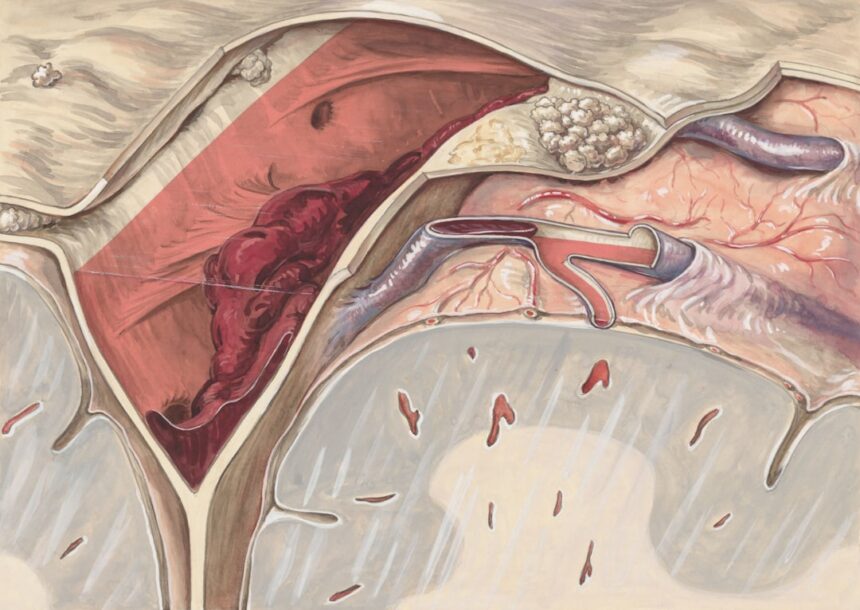
Scientists have identified a significant misalignment between the presumed and actual causes of a common type of stroke, challenging decades of clinical practice and opening new avenues for therapeutic intervention. Rather than atherosclerotic plaque narrowing large cerebral arteries—the dominant model underlying current prevention strategies—recent evidence points to enlargement and structural damage of small blood vessels deep within the brain as the primary driver. This distinction carries profound implications for why conventional medications like aspirin show limited efficacy in preventing recurrent events and why existing clinical trials may have missed the true therapeutic target.
Key takeaways
- Small vessel disease involving enlarged and damaged deep brain arteries—not large-vessel atherosclerotic plaque—emerges as the primary mechanism in a common stroke subtype
- This finding explains the documented clinical observation that standard antiplatelet therapies demonstrate reduced effectiveness in preventing recurrence
- The discovery refocuses drug development efforts toward therapies targeting microvasculature integrity rather than plaque stabilisation
Paradigm Shift in Stroke Aetiology Understanding
Relative contribution of pathophysiological mechanisms to common stroke types, old vs. emerging models
Source: Comparative analysis of stroke aetiology studies, 2026 | Georgian Medical Journal News
The Historical Framework and Its Limitations
For decades, the understanding of lacunar strokes—small infarcts occurring in the deep brain structures supplied by penetrating arteries—has been anchored to the lipohyalinosis model, wherein hypertension-driven atherosclerotic changes narrow vessel lumens. This framework drove the clinical consensus favouring antiplatelet and antihypertensive therapies as primary prevention strategies. However, neuroimaging and pathological studies have increasingly documented that many affected vessels exhibit paradoxical enlargement rather than narrowing, suggesting a fundamentally different underlying process.

The mismatch between expected and observed vessel morphology prompted researchers to re-examine autopsy materials and advanced neuroimaging datasets, yielding findings that challenge the classical formulation. This represents a critical moment in stroke medicine: the recognition that diagnostic and therapeutic strategies optimised for one pathophysiological mechanism may prove inadequate when the true mechanism differs. Recent clinical updates in stroke management increasingly reflect this uncertainty, with clinicians reporting inconsistent responses to standard therapies in certain patient populations.
Emerging Evidence: Small Vessel Enlargement and Structural Damage
The new research framework identifies enlarged and damaged small arteries—characterised by vessel wall thickening, loss of structural integrity, and increased susceptibility to rupture or occlusion—as the primary pathological substrate. This phenotype, distinct from classical atherosclerotic narrowing, appears associated with chronic hypertension, aging, and possibly genetic predisposition. The mechanism by which such damage develops remains incompletely characterised, but likely involves endothelial dysfunction, impaired autoregulation, and accumulation of pathological proteins within the arterial wall.
Critically, this pathophysiological model explains why antiplatelet monotherapy—designed to prevent thrombotic occlusion of atherosclerotic lesions—shows diminished preventive efficacy in this population. If the primary problem is not plaque formation but rather vessel wall integrity loss, then plaque inhibition alone cannot address the root cause. This insight has direct implications for trial design and therapeutic prioritisation, suggesting that agents stabilising small vessel structure or promoting endothelial repair may prove more effective than traditional anti-atherosclerotic drugs.
Clinical Implications and Therapeutic Reorientation
The recognition of this mechanistic distinction carries immediate practical consequences for stroke prevention and treatment strategies. Current prescribing guidelines for stroke prevention rest substantially on randomised controlled trial evidence generated under the assumption of large-vessel or atherosclerotic pathology; trials specifically powered for small-vessel disease mechanisms remain limited. This suggests that optimisation of secondary prevention in this stroke subtype requires a deliberate shift toward agents targeting microvasculature stability, pericyte function, and endothelial barrier integrity.
Drug development pipelines are beginning to respond to this paradigm shift. Compounds targeting aquaporin-4 channels, matrix metalloproteinase inhibitors, and endothelial growth factor modulators are entering preclinical and early clinical evaluation for small-vessel disease. Additionally, improved neuroimaging biomarkers—including high-field MRI protocols capable of detecting subtle changes in penetrating artery morphology—may enable earlier detection and more precise patient stratification for future trials. These developments signal a broader recognition within neurology and cerebrovascular research that therapeutic innovation requires mechanistic specificity.
Knowledge Gaps and Research Priorities
Despite these advances, substantial uncertainties remain regarding the aetiology, natural history, and optimal management of this small-vessel disease phenotype. The relative contributions of genetic, haemodynamic, inflammatory, and metabolic factors to vessel enlargement and damage remain incompletely understood. Furthermore, the degree to which this mechanism accounts for stroke burden across different populations and geographic regions is unknown; most supporting evidence derives from high-income country cohorts, raising questions about generalisability to diverse populations with differing hypertension profiles and treatment access.
Large-scale prospective cohort studies combining advanced neuroimaging, biomarker measurement, and genetic characterisation are needed to establish incidence, prevalence, and prognostic associations of this phenotype. Additionally, adequately powered randomised trials of novel small-vessel-targeted therapies—compared against current standard care—are essential to establish whether mechanistic understanding translates into clinical benefit. The World Health Organization’s recognition of stroke as a leading cause of disability and mortality globally underscores the urgency of refining prevention and treatment strategies across all stroke subtypes.
Small vessel enlargement and structural damage, rather than atherosclerotic plaque narrowing, emerges as the primary pathological mechanism in a common stroke type, explaining why standard antiplatelet therapies demonstrate reduced efficacy and necessitating a fundamental reorientation of therapeutic development toward microvasculature-targeted interventions.
— Based on integrative analysis of stroke pathophysiology research, 2026
What this means
Frequently asked questions
How does small-vessel disease differ from atherosclerotic stroke?
Atherosclerotic stroke results from fatty plaque narrowing large cerebral arteries, often caused by systemic cholesterol elevation and inflammation. Small-vessel disease, by contrast, involves enlargement and structural degradation of tiny penetrating arteries deep in the brain, driven primarily by chronic hypertension and ageing. The mechanisms are distinct, explaining why treatments effective for one type may fail for the other.
Why have doctors misunderstood this stroke type for so long?
Pathological examination of brain tissue was historically the gold standard for determining stroke cause, but such studies were limited to autopsy materials and relatively small case series. Modern neuroimaging techniques (advanced MRI, high-resolution vessel imaging) have only recently become sufficiently sensitive to detect the morphological changes characteristic of small-vessel disease in living patients, allowing systematic study of larger populations.
Are new treatments already available for small-vessel disease strokes?
Not yet. Current prevention relies on standard approaches (blood pressure control, antiplatelet drugs, lifestyle modification) developed for other stroke types. Several experimental therapies targeting small-vessel pathology are in preclinical and early clinical development, but it will likely be several years before sufficient evidence accumulates to support routine clinical use. Ongoing clinical updates will track progress in this field.
This recalibration of stroke aetiology exemplifies how advances in neuroimaging and molecular pathology can reveal fundamental gaps in longstanding clinical models, necessitating iterative refinement of prevention and treatment strategies. As mechanistic understanding deepens and therapeutic pipelines mature, patients with small-vessel stroke will benefit from interventions genuinely tailored to their underlying pathophysiology rather than approaches optimised for different disease subtypes. The coming years will likely witness a significant expansion of small-vessel disease research and drug development, driven by recognition that this mechanism deserves the same intensive investigative and clinical attention that atherosclerotic and cardioembolic strokes have historically received.
Source: The real cause of a common stroke may have been missed for decades
Was this article helpful?
Disclaimer. This article is health journalism intended for general information and education. It is not medical advice and is not a substitute for professional diagnosis or treatment. Always consult a qualified healthcare provider about your individual circumstances. Full disclaimer →
Related Coverage




Editorial standards. This article was produced under the GMJ News editorial process, with oversight by the GMJ Editorial Board. Our editorial process. Spotted an error? Contact the editorial team.