


Home › Topics › Water Fluoridation
Water Fluoridation
GMJ News knowledge hub · last reviewed August 2026 · Georgian Medical Journal
SummaryStatisticsGlossaryGMJ newsFAQDocumentsOrganizationsResearch
Community water fluoridation — adjusting drinking water to around 0.7 mg/L of fluoride — was named one of the ten great public health achievements of the twentieth century, and in 2025 became the most politically contested chemical exposure in the United States: Utah and Florida enacted the first statewide bans, and federal health leadership moved against the practice. The honest evidence picture has three layers: fluoride at recommended levels prevents dental caries, with a smaller marginal benefit today than in the pre-toothpaste era; exposures above 1.5 mg/L — roughly double the recommended level — are associated with lower IQ in children in a 2024 US National Toxicology Program review; and no reliable evidence shows neurodevelopmental harm at 0.7 mg/L, where the policy actually operates. The fight is genuinely about how to weigh a shrinking but real benefit, an uncertain safety margin and the ethics of mass medication (WHO oral health fact sheet).
Key messages
SETTLED: fluoride prevents dental caries
The cariostatic effect of fluoride is among the best-established facts in preventive dentistry — it inhibits demineralisation, promotes remineralisation of enamel and suppresses cariogenic bacteria, acting predominantly topically. Water fluoridation demonstrably reduced decay in the twentieth century, and topical fluoride (toothpaste, varnish) is unambiguously effective. No serious scientific position disputes that fluoride, appropriately dosed, protects teeth.
SETTLED, AND SMALLER THAN IT WAS: the modern marginal benefit
The 2024 Cochrane review made an honest and widely misquoted finding: studies conducted after 1975 — when fluoride toothpaste became universal — show a smaller additional benefit from water fluoridation than the dramatic pre-1975 effects, roughly a quarter of a tooth surface saved per child on average, with uncertainty about how much fluoridation still narrows socioeconomic inequalities. This is not evidence that fluoridation stopped working; it is evidence that its marginal contribution shrank once fluoride reached everyone through toothpaste. Both defenders quoting 1950s effect sizes and opponents claiming Cochrane found no benefit are misusing the same document.
SETTLED AT HIGH DOSE, OPEN AT THE MARGIN: fluoride and IQ
The 2024 US National Toxicology Program monograph concluded with moderate confidence that fluoride exposure above 1.5 mg/L — twice the recommended level, occurring mainly in naturally fluoridated regions of China, India and Iran — is associated with lower IQ in children. It explicitly found insufficient data to determine effects at 0.7 mg/L, and the studies driving the association have significant confounding limitations. The genuine open question is the width of the safety margin between 0.7 and 1.5; the claim that fluoridated US or Irish water lowers IQ is not supported by the monograph its proponents cite.
UNSUPPORTED: harm at recommended levels
At 0.7 mg/L the demonstrated adverse effect is mild dental fluorosis — faint white enamel mottling, cosmetic in the large majority of cases. Claims linking fluoridation at recommended levels to cancer, bone disease, thyroid failure or neurodevelopmental injury have been repeatedly examined by systematic reviews across seventy years and are not supported. Skeletal fluorosis, the genuinely serious outcome, occurs at chronic exposures many times higher, almost entirely from naturally over-fluoridated groundwater — which is the actual global fluoride problem, affecting tens of millions.
THE REAL ARGUMENT: ethics, consent and shrinking benefit
The intellectually serious case against fluoridation was never toxicological — it is that mass medication without individual consent requires a large, otherwise unachievable benefit, and that as the marginal benefit shrinks and alternatives (toothpaste, varnish programmes) exist, the ethical calculus shifts. Utah (May 2025) and Florida (July 2025) enacted the first US statewide bans, federal health leadership moved to withdraw the CDC recommendation, and modelling published in JAMA Health Forum projected that national cessation would produce some 25 million additional decayed teeth and 9.8 billion dollars in costs over five years, concentrated in low-income children. That projected regressive burden is the strongest remaining argument for the policy; informed societies can legitimately weigh it differently.
Why this became the moment — the transmission is documentable
Three events converged: the NTP monograph (August 2024) gave the IQ concern an institutional citation; a federal court ruling (September 2024) ordered the EPA to address fluoride under toxic-substances law, generating 'court finds risk' headlines; and a new US health administration openly hostile to fluoridation converted a fringe position into state legislation within months. Each event is real and each is routinely overstated — the monograph concerned high-dose exposure, the ruling found risk sufficient to require regulatory response rather than proof of harm, and clinical practice should track the evidence rather than the politics.
Key statistics
0.7 mg/L
recommended fluoridation level in the US — WHO guideline maximum for fluoride in drinking water is 1.5 mg/L
US PHS / WHO>1.5 mg/L
exposure level above which the 2024 NTP monograph found a moderate-confidence association with lower child IQ
NTP 2024~0.24
fewer decayed primary tooth surfaces per child from fluoridation initiation in post-1975 studies — the honest modern effect size
Cochrane 20242 states
Utah and Florida — first US statewide fluoridation bans, effective May and July 2025
State legislation25.4 million
projected additional decayed teeth in US children over 5 years if fluoridation ceased nationally
JAMA Health Forum 2025Tens of millions
people worldwide affected by fluorosis from naturally over-fluoridated groundwater — the actual global fluoride problem
WHOWater fluoridation — where the disagreement actually lies
Glossary of key terms
Latest GMJ coverage

How the gut absorbs nutrients: a seven-meter journey from mouth to colon
27/07/2026

How the gut absorbs nutrients with molecular precision: A seven-meter biochemical assembly line
16/07/2026

Gut’s 7-Meter Assembly Line Maps Nutrient Absorption with Molecular Precision
24/05/2026

How Your 7-Meter Gut Functions as a Molecular Assembly Line for Nutrient Absorption
21/05/2026
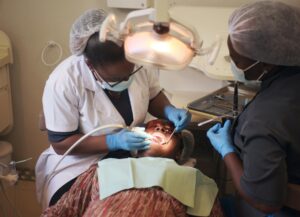
Tanzania Launches New Oral Health Strategy to Close Care Gaps and Boost Workforce
21/05/2026
Frequently asked questions 12 Q&A — structured for Google featured snippets and AI discovery
Knowledge hub: guidelines, conventions and reports
Organizations working in migration and health
Related health topics
Oral healthChild healthWater and sanitationHealth misinformationVaccine hesitancyLead poisoning
About this hub. Produced by the GMJ News Editorial Team as a public-good service. Every statistic is linked to its primary source. Documents are preserved in the GMJ Repository with full attribution. Georgian Medical Journal · Contact the editorial team