Updated 13/09/2026
The citric acid cycle—also called the Krebs cycle or tricarboxylic acid cycle—is the metabolic engine that converts nutrients into usable cellular energy in nearly all living organisms. Operating continuously in the mitochondria of human cells, this eight-step biochemical pathway oxidizes acetyl-CoA derived from carbohydrates, fats, and proteins, generating the electron carriers and energy molecules essential for life.
Key takeaways
- The citric acid cycle is the central metabolic hub that processes all three macronutrient types—carbohydrates, fats, and proteins—into usable cellular energy
- Each complete cycle generates 3 molecules of NADH, 1 molecule of FADH2, and 1 molecule of GTP (or ATP), which power ATP synthesis in the electron transport chain
- Disruption of citric acid cycle function is implicated in metabolic diseases, cancer metabolism reprogramming, and mitochondrial disorders
Study at a Glance
| Topic | Cellular bioenergetics and intermediary metabolism |
| Process | 8-step enzymatic cycle occurring in mitochondrial matrix |
| Key substrates | Acetyl-CoA, NAD+, FAD, CoA, ADP |
| Key products | NADH, FADH2, GTP/ATP, CO2, reduced intermediates |
| Evolutionary origin | Conserved across prokaryotes and eukaryotes |
Energy Yield from Complete Glucose Oxidation
ATP production across three major metabolic pathways
Source: Biochemistry textbooks (Berg, Tymoczko, Stryer); GMJ News Desk | Georgian Medical Journal News

The Eight-Step Cycle That Powers Cellular Life
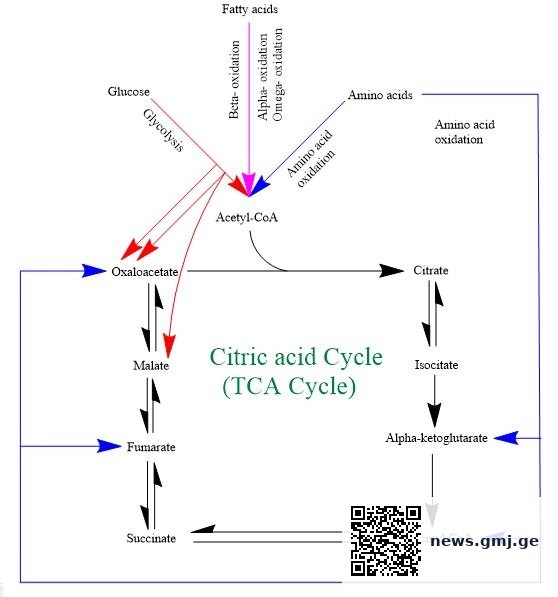
The citric acid cycle begins when acetyl-CoA—a two-carbon unit derived from pyruvate (from glycolysis), fatty acid oxidation, or amino acid catabolism—condenses with the four-carbon molecule oxaloacetate to form citrate. This reaction, catalyzed by the enzyme citrate synthase, marks the entry point for all fuel sources into the cycle. Over the next seven steps, citrate is systematically rearranged, oxidized, and decarboxylated, releasing two carbon atoms as carbon dioxide while simultaneously transferring electrons to NAD+ and FAD, which carry them to the electron transport chain.
Each turn of the cycle regenerates oxaloacetate, allowing it to accept another acetyl-CoA and repeat the process. This elegant recycling mechanism means that a small amount of oxaloacetate can process many acetyl groups, making the cycle highly efficient. The cycle operates continuously in fed and fasting states, adapting its flux based on cellular energy demand and the availability of its substrates.
From Macronutrients to Molecular Energy
A key feature of the citric acid cycle is its role as a metabolic crossroads. Glucose enters through glycolysis as pyruvate and is converted to acetyl-CoA by the pyruvate dehydrogenase complex. Fatty acids are broken down to acetyl-CoA via beta-oxidation in the mitochondria. Amino acids from protein breakdown are converted into various cycle intermediates—some directly into oxaloacetate, succinate, or alpha-ketoglutarate—allowing all three macronutrients to be processed through a unified metabolic pathway. This flexibility is why the cycle remains central to nutrition and energy metabolism across diverse dietary states, from ketogenic diets high in fat to carbohydrate-rich diets.
The energetic output of the cycle is captured not only as electron carriers (NADH and FADH2) but also as high-energy phosphate bonds. In each cycle, the enzyme succinyl-CoA synthetase catalyzes the direct generation of one molecule of GTP (or ATP in some tissues), which can be used immediately or converted to ATP via nucleoside diphosphate kinase. The NADH and FADH2 generated represent the largest energy harvest: these molecules donate their electrons to the electron transport chain, where oxidative phosphorylation drives the synthesis of approximately 26–28 additional ATP molecules per glucose oxidized.
When the Cycle Falters: Metabolic Disease and Cancer
Dysfunction of the citric acid cycle underlies several clinically important conditions. Mutations in genes encoding cycle enzymes—particularly in succinate dehydrogenase (SDH), fumarase, or isocitrate dehydrogenase (IDH)—cause rare mitochondrial disorders characterized by progressive neurological decline, muscle weakness, or cancer predisposition. These genetic defects disrupt electron flow and energy production, revealing how tightly cellular function depends on cycle integrity.
Cancer cells often reprogram their metabolism, a phenomenon termed the Warburg effect: they preferentially use glycolysis even in the presence of oxygen, generating lactate rather than fully oxidizing glucose through the citric acid cycle. However, emerging research shows that the cycle remains critical for cancer cell biosynthesis and survival; malignant cells often rewire rather than abandon cycle function to support lipid synthesis and redox balance. This metabolic adaptation has therapeutic implications: inhibiting specific cycle enzymes or their upstream regulators shows promise as an anti-cancer strategy in early clinical trials.
The Constant Rhythm of Biochemistry
At rest, a human body cycles through the citric acid cycle billions of times per second across all tissues. In the heart—a tissue that relies almost entirely on oxidative metabolism—the cycle is particularly active, matching the ATP demand of continuous contraction. In the liver and brain, the cycle supports both energy production and the synthesis of amino acids and other biomolecules. Even during sleep, this “quiet rhythm of biochemistry” persists, maintaining the fundamental molecular processes that sustain life.
The citric acid cycle generates three molecules of NADH, one molecule of FADH2, and one molecule of GTP per acetyl-CoA oxidized, ultimately yielding approximately 30–32 ATP molecules per glucose through coupled oxidative phosphorylation—a yield that supports the high metabolic demands of human tissues.
— Standard biochemistry textbooks and peer-reviewed metabolism reviews
What this means
Frequently asked questions
What is the difference between the citric acid cycle and glycolysis?
Glycolysis occurs in the cytoplasm and breaks down one glucose molecule into two pyruvate molecules, generating 2 ATP directly and producing NADH. The citric acid cycle occurs in the mitochondrial matrix and processes the acetyl-CoA derived from pyruvate (and other fuels), generating electron carriers (NADH and FADH2) that drive ATP synthesis in the electron transport chain. Together, they enable complete glucose oxidation.
Can the citric acid cycle run without oxygen?
No. The citric acid cycle itself does not require oxygen directly; however, its electron carriers (NADH and FADH2) must be regenerated by donating electrons to the electron transport chain, which requires oxygen as the final electron acceptor. Without oxygen, NADH accumulates, the cycle slows, and ATP production drops sharply, leading to the conditions seen in hypoxia or anaerobic metabolism.
Why is the citric acid cycle sometimes called a “hub” of metabolism?
The cycle is central because all three macronutrients (carbohydrates, fats, and proteins) feed into it as acetyl-CoA or as direct intermediates. It also supplies building blocks for biosynthesis of amino acids, nucleotides, and other molecules. This convergence of multiple metabolic pathways and its role in both energy production and biosynthesis make it the metabolic hub of the cell, integrating energy and material flow across the entire organism.
The citric acid cycle exemplifies a fundamental principle of biology: complexity arises from elegantly simple, recursive mechanisms. This eight-step dance of electrons, protons, and molecular bonds has persisted essentially unchanged for over 2 billion years of evolution, underscoring its primacy in the architecture of life. As medicine increasingly focuses on metabolic dysfunction in aging, cancer, and neurodegeneration, a deeper mechanistic understanding of the cycle—and the ability to measure and modulate its activity—will likely become central to precision health. The next generation of diagnostics and therapeutics may well be written in the language of this ancient biochemical pathway.
Source: Chemistry writes the story of life
🗺️ Find certified Georgian healthcare providers: sheniekimi.ge — Georgia Health Map · 998 clinics · 6,600+ doctors · 2,296 pharmacies
Was this article helpful?
Disclaimer. This article is health journalism intended for general information and education. It is not medical advice and is not a substitute for professional diagnosis or treatment. Always consult a qualified healthcare provider about your individual circumstances. Full disclaimer →
Related Coverage




Editorial standards. This article was produced under the GMJ News editorial process, with oversight by the GMJ Editorial Board. Our editorial process. Spotted an error? Contact the editorial team.